

1. How did we get here?
The central banks spent thirty years manipulating the price of money below its natural level. Since Paul Volcker, they were praised for taming inflation they did not tame - that was the work of the structural forces of the Great Moderation, above all China's arrival in the world trading system - and in the process they convinced governments that debt was costless. It was not. The bill is now being prepared, and for the first time since the early 2000s there is no easy way to pay it: the toolkit that resolved every prior crisis is precisely what the bond market will no longer tolerate.
Today’s bond market stresses are the culmination of distortions. Easy money encouraged successive waves of debt accumulation: first among corporates during the TMT era, then households in the run-up to the Global Financial Crisis, and most recently governments alongside an AI investment boom of historic proportions. The financialisation that followed diverted capital away from productive investment, contributing to weaker productivity growth and an increasing reliance on deficit spending to sustain economic activity.
For now, AI investment is helping support revenues and economic growth, but the bill will eventually come due. Governments running persistent deficits and an AI build-out demanding unprecedented levels of capital are competing for funding at precisely the moment traditional buyers of sovereign debt are stepping back. The result is a growing imbalance between the supply of capital and the demand for it.
Higher interest rates are both the symptom of that imbalance and, ultimately, its cure. History suggests that the sustained manipulation of interest rates rarely ends well. In The Price of Time, Edward Chancellor chronicles five millennia of states, nations and empires that learned this lesson the hard way. The United States may now be confronting it once again.
Chart 1: Debt Growth Outpacing GDP Growth
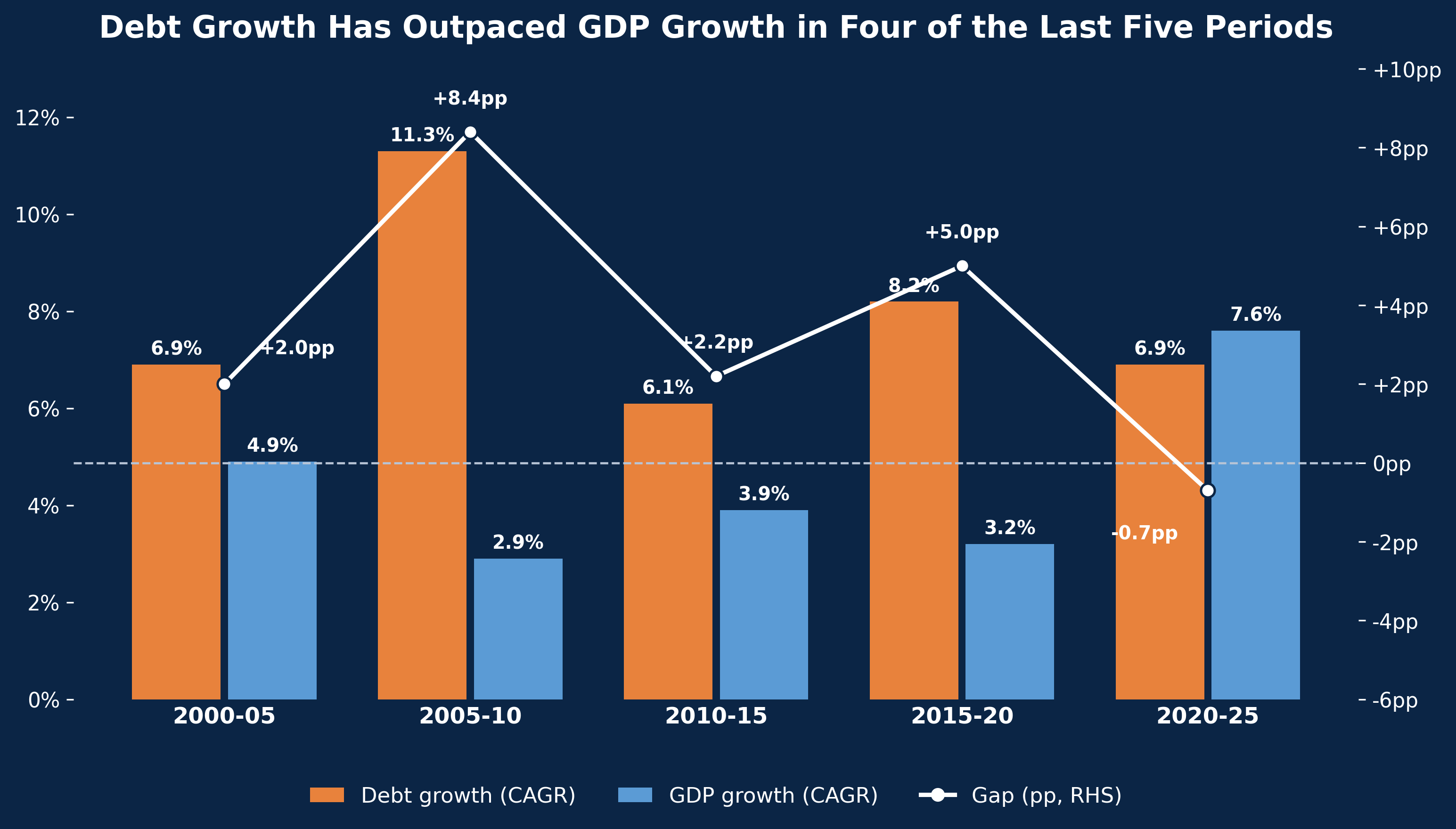
Source: FRED as at 31/12/25
The good news, and it is genuine, is that the US retains the easiest path out of any major economy - energy, technology, a relatively young workforce, deep and (still) trusted capital markets, and a tax take that is low by developed-world standards and therefore has room to rise. The problem is not the absence of solutions; it is a crisis of political will. The persistent prioritisation of short-term electoral incentives over sound long-term decision making has left structural problems unresolved and increasingly difficult to address. Policymakers will, in our view, try all the wrong answers first - operation twist, drawing down the Treasury’s cash balance, messaging - before they are forced toward the right ones. The affordability debate is the bond market’s best friend. Inflation helped bring down the Biden administration politically and may yet do the same to Trump 2.0. Few politicians will be eager to repeat the experience.
The deeper damage is structural. Decades of monetary policy geared towards boosting asset prices through the wealth effect have distorted economic signals, while a tax system increasingly tilted towards investment income bears its share of the blame. Taxing capital at a fraction of the rate applied to labour, compounded over decades, has predictable and corrosive consequences: it channels resources towards financial engineering and away from work, innovation and productive enterprise. Yet the manipulation of interest rates remains the original sin. Interest rates are the single most important price in a market economy, balancing savings and investment across the system. Suppress that signal and the circuitry breaks down. Resources are misallocated, speculation is rewarded over enterprise, and the normal restraints on exuberance disappear. Wall Street will always find a story for why an asset is cheap and never overvalued.
Table 1: The same policy, the same result — asset inflation, not productive growth
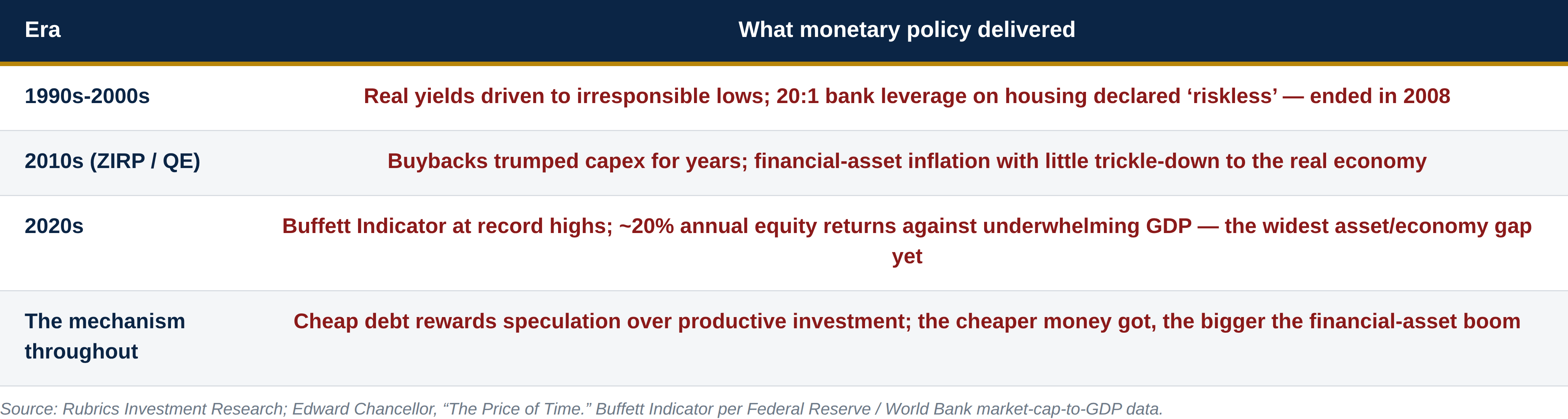
Chart 2: Buffett Indicator (US Market Cap % of Global GDP)
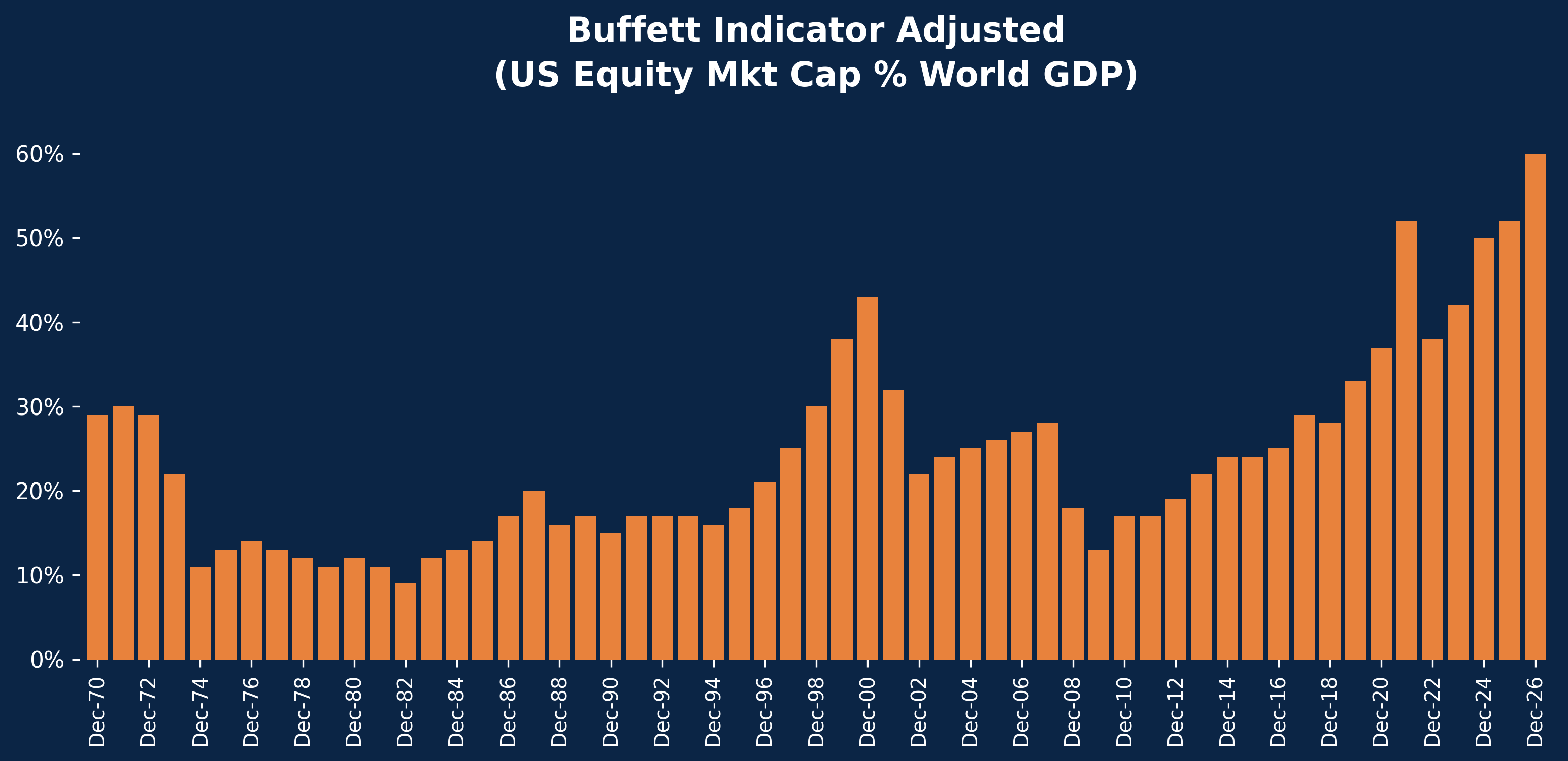
Source: Bloomberg as at 31/12/25
2. What is Different this Time?
We have argued for some time that the end of the Great Moderation is the defining macro fact of this decade. The era in which intervention appeared costless - in which trillions of dollars of debt could be accumulated with no apparent penalty - has ended, and the bill is being prepared. What tells us this time is serious is the behaviour of policymakers themselves: their reaction reveals that they too can see there are very few, if any, easy ways out. For the first time in over 25 years, the situation demands real solutions rather than another round of kicking the can.
Today’s problems are fiscal and debt-driven but, most importantly, they are also a productivity problem. The US economy has become deeply inefficient, borrowing and spending its way to growth. Strip out government deficit spending and the AI build-out and the economy generates little underlying real growth. That is an unsustainable model, sustained only by an economy operating at two speeds: corporate investment remains strong and pushes rates higher, while a weakening consumer argues for lower rates. This is why higher rates are simultaneously part of the problem and part of the solution. They hurt in the short term, but they are also the mechanism by which resources are redirected towards their most productive uses. AI may ultimately prove transformational, but the extraordinary speed and scale of today’s investment has raced far ahead of any clear evidence on future revenues. In that environment, higher rates serve an important disciplining function, forcing investors to apply more demanding return hurdles and more realistic discount rates to highly uncertain future cash flows.
This is a supply-and-demand problem, not an inflation problem
The most important analytical point in this report is this: the driver of higher rates today is not inflation. It is the term premium - the supply of and demand for capital. Once that is understood, the entire picture reorganises around a simple imbalance.
Table 2: Too much capital demanded, too few willing to supply it — the term premium does the rest

Chart 3: 10 Year Treasury Decomposition
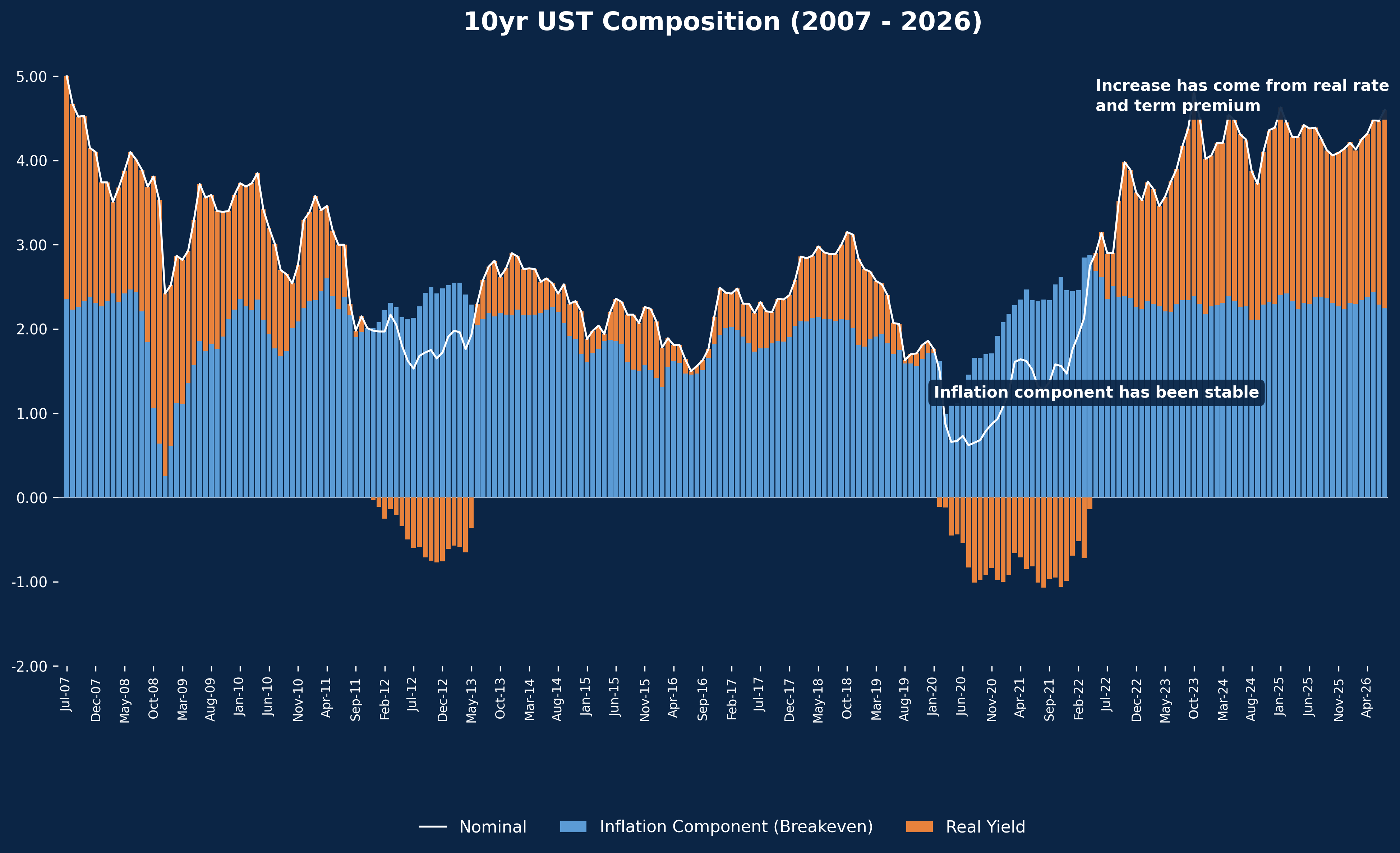
Source: Bloomberg as at 31/12/25
The demand side deserves particular emphasis because part of it is self-inflicted. The US system — both its Treasury market and its equity market — is held up to a remarkable degree by foreign capital. To then pursue geopolitical policies that actively undermine the dollar’s role in global trade, from the weaponization of dollar assets to the tariff agenda, is to erode the very demand the system depends upon. Gold is now behaving as the world’s premier reserve asset, and yet the policies that pushed it there continue. It is, in the plainest terms, a contradiction the US cannot afford.
3. The Geopolitical Layer
The rules-based system that underpinned the Great Moderation is breaking up. A new template for world trade will emerge over the next decade - and, as always, the transition arrives with political upheaval.
What makes this moment so much harder to navigate is that the rules-based order which supported the Great Moderation is fracturing. Over the coming decade a new global template for trade and commerce will take shape, and - as such transitions always do - it will bring considerable political volatility. Our own work as far back as 2015 on the macroeconomic environment set out how these transformations tend to end in significant political upheaval. The pattern is consistent: electorates generally exhaust every bad option before they arrive at a workable one, and the US is visibly moving through that process now, swinging from a populist-right MAGA movement toward a more assertively left-leaning Democratic alternative.
India offers an instructive precedent. When Congress lost power to the BJP in 2014, it was in large part because voters had tired of an inflationary subsidy model that pushed the price of everyday staples up faster than the subsidies could compensate. They chose a more pragmatic approach. The lesson generalises: voters punish the inflation that vote-buying produces, and they do so decisively.
A final point of scope. Although this report focuses on the United States, the underlying policy error was global. The same cheap-money design that originated in the Eccles Building was exported worldwide - negative rates across Europe, a debt-fuelled housing bubble in China. The only real variation was in where the debt was directed: in China, toward industrial production rather than consumption. But the outcome - too much debt, too little productive return - is the same everywhere, and so are the challenges now emerging from it.
4. The AI Dimension - Solution and Problem all at Once
For the first time since the TMT and shale booms, the US is investing at scale in something that may genuinely raise productivity. This is one solution. The way it is being financed is the problem.
It is important to be fair to the AI investment case. For the first time since the mass build-out of telecoms in the late 1990s and shale a decade later, the US is deploying capital at genuine scale into something with real productive potential. At the very least, the economy will be left with a large stock of compute; precisely what it will be used for is not yet clear, but the potential is substantial. The difficulty is that AI is, simultaneously and inseparably, part of the here-and-now problem.
Three ways AI is adding to the strain
— It is consuming vast quantities of capital in a world where the competition for real capital is already intense. With too little genuine capital available, the build-out is being funded increasingly with debt — pushing rates higher for every other borrower in the economy.
— It is inflationary through its own supply chain. The sheer scale of the spend is bidding up the price of everything from microchips and memory to electricity and grid capacity.
— It is amplifying the wealth effect. The equity gains accrue overwhelmingly to the top decile who own the stocks, and that concentrated wealth effect adds further to demand-side inflation.
Chart 4: Corporate Bond Sales Crowding Out
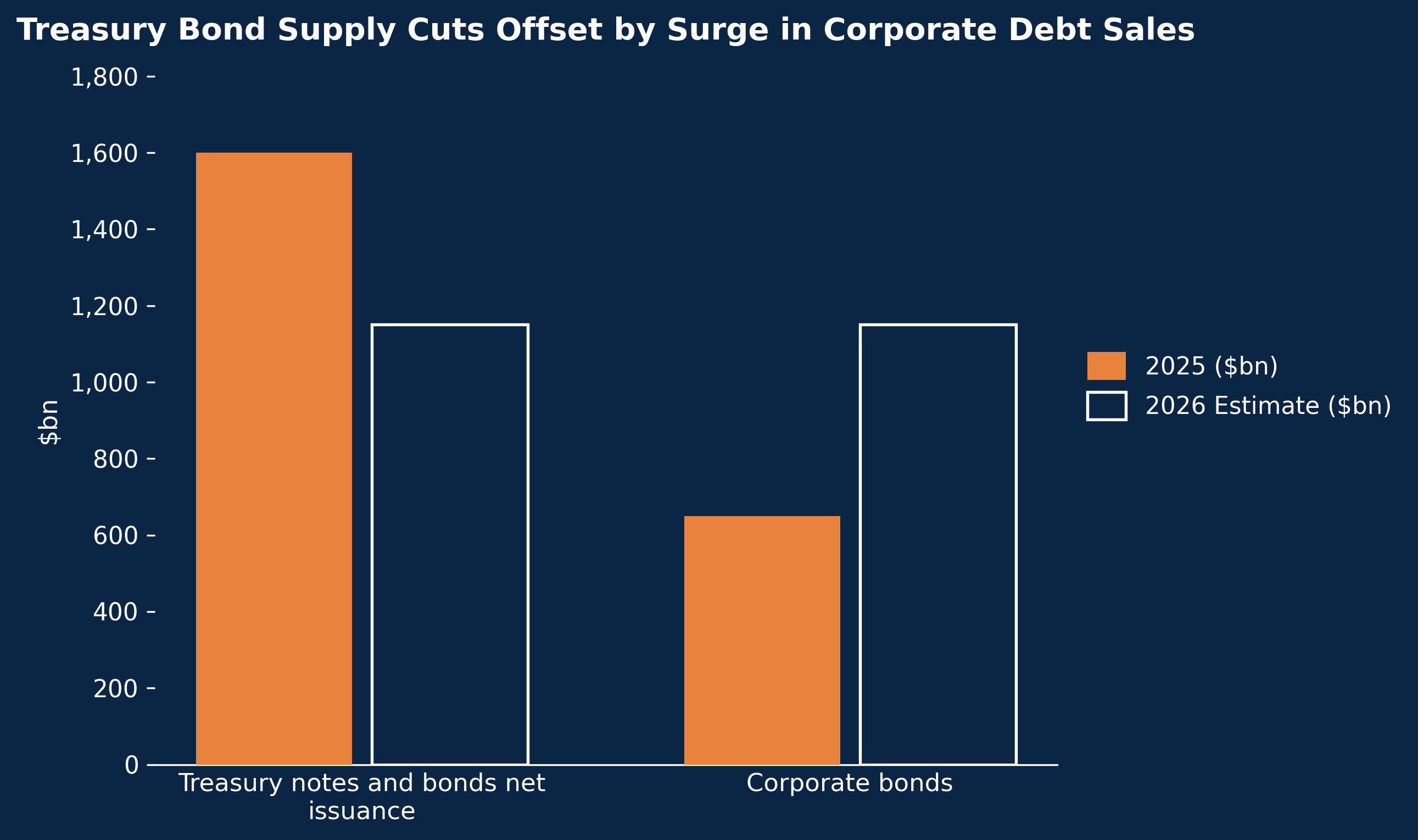
Source: Bloomberg as at 31/07/26
The returns question is now unavoidable
As capital grows more expensive and input costs rise, the return-on-investment question becomes serious - and at this stage the honest answer is that the numbers do not work. Estimates on the order of US$2.5 trillion1 of annual revenue would be required to justify the spending within five years, a figure that is simply not attainable at current global GDP levels without severe economic dislocation. Competition is arriving fast from cheaper Chinese models. And the reported earnings that sustain the narrative rest on the same financial architecture that flattered the late 1990s: revenues inflated by borrowed money while costs are deferred down the road through extended depreciation schedules - supplemented, remarkably, by the non-cash “revenue” of marking up the balance-sheet value of stakes in OpenAI and Anthropic at valuations set by their own investors.
There is no historical precedent for capital spending and debt of this magnitude producing a productive payoff without a severe capital-destruction event in between - from the canals to the railroads to telecoms, the mania and the crash come first, then the payoff. The economy sitting beneath this build-out - the bottom half of the K, with no real private-sector job growth, falling real wages and high food and energy inflation - is in no condition to absorb the fallout. If AI disappoints it will bring inflation down, but it will bring a great deal else down with it, and the rest of the economy cannot stomach that right now. The payoff ultimately depends on OpenAI and Anthropic delivering; recent news of price-cutting and pressure on top-model usage makes that a tall order.
5. The Cracks are Showing
Every policy move now draws a negative reaction. That is the market’s way of saying there are no easy fixes left.
The market’s focus is squarely on the rates market, and rightly so - though the most acute near-term danger is the oil price and the inflation it could unleash if it runs out of control. What is telling is the change in the market’s reflexes. Since the 2022 inflation outbreak, the pattern was reliable: the 10-year yield would climb toward 4.70%, panic would set in, action would be taken, and yields would fall - until the next policy misstep, from ‘Liberation Day’ tariffs to the Iran war, sent them back up. Recall that yields were below 4% just before the war, and are back near 4.70% now. The difference this time is that every policy move draws a negative reaction, because the market can see there are no easy fixes left. Policymakers will need genuinely better solutions.
Chart 5: 10 Year Treasury, Term Premium and Intervention Points
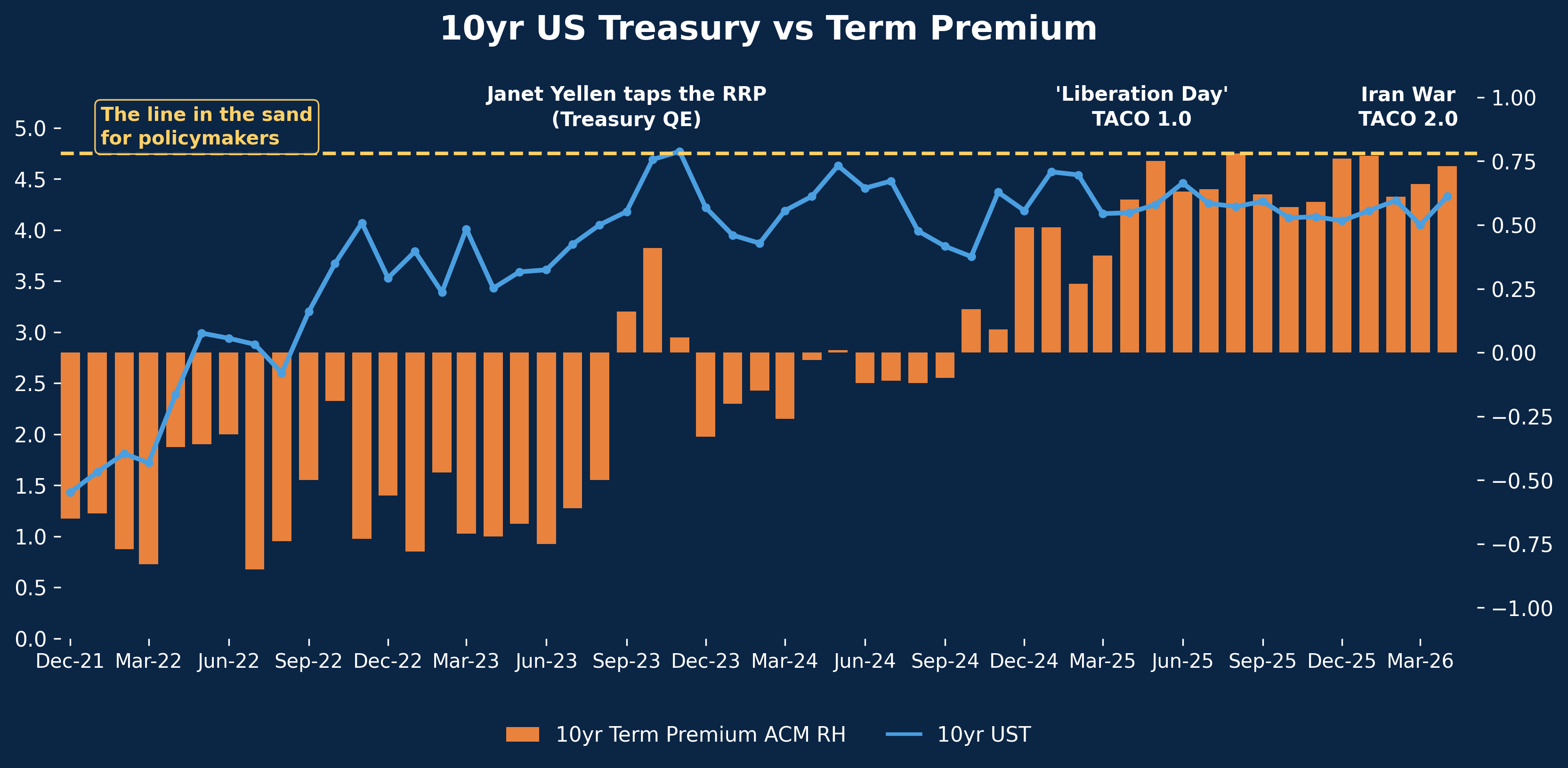
Source: Bloomberg as at 31/07/26
It is not only rates
The stress is visible across the system. Private credit and its incestuous relationship with private-equity-owned insurance is now in the headlines - from the losses tied to high-profile sports-franchise financing to German pension funds. The model of layering leverage upon leverage on businesses that are simultaneously being stripped of assets does not survive a rising-rate environment and a struggling consumer; one need only look at same-store earnings at the largest US retailer Walmart. Off-balance-sheet AI financing now openly acknowledged at over US$3.1 trillion2 is not fraud, but it is an open invitation to focus on revenues rather than costs - there is more than a little of Enron about it, albeit with greater transparency. As funding becomes harder and credit-default-swap pricing on some names rises, new and ever-more-elaborate financing structures are being invented to keep the money flowing. When a business genuinely earns its return, none of this engineering is necessary. That Nvidia must now assemble multi-bank and private-credit funding structures for its own customers3, because individual client financing has become problematic, speaks volumes.
Table 3: Extreme leverage, thin revenue — and the costs have barely begun to be counted
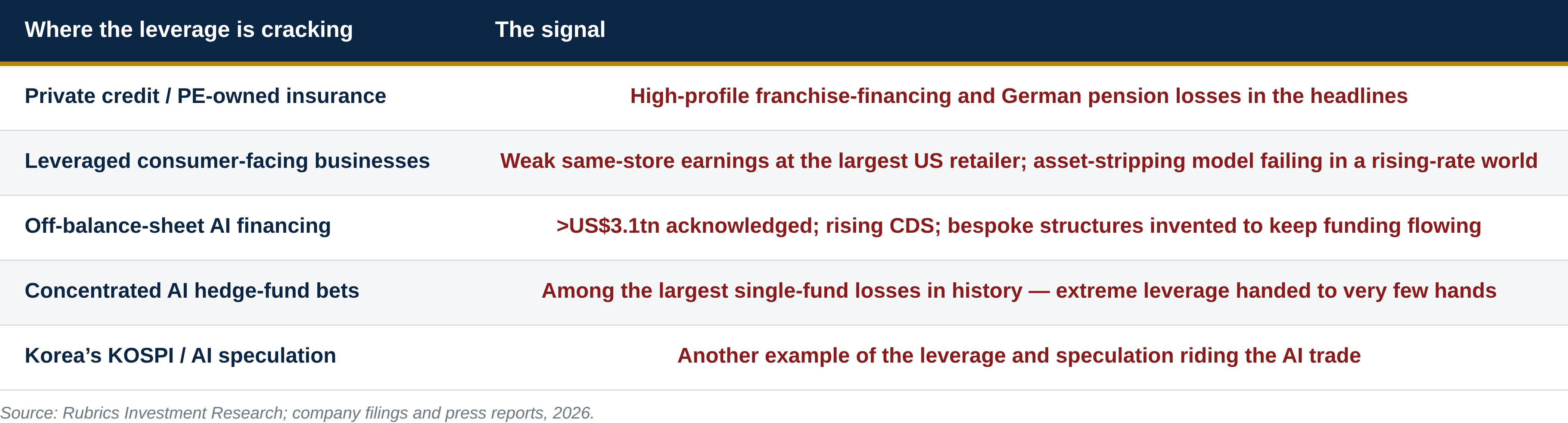
Banks, energy and utility names are performing well, but for reasons that have little to do with sustainable productive gains. The uncomfortable truth is that today’s AI spend is unsustainable, and every additional trillion committed deepens the eventual adjustment: too much leverage, not enough revenue — and that is before the true costs have even begun to be counted.
6. The Key Players: Bessent and Warsh
This crisis is not of their making, but they occupy the hot seat, and the market now looks to them for solutions. Neither has yet delivered one.
Scott Bessent - Treasury
Bessent is the more curious case. He knows better than his current position suggests: his own past teaching makes clear he understands that tariffs are inflationary and are paid by the buyer, not the exporter - yet alongside the President he now argues otherwise. His Senate testimony that the tax cuts would pay for themselves was, to put it charitably, unconvincing; one could see he did not believe it as he said it. To his credit, he has tried to steer the administration in the right direction - he reportedly urged a rapid end to the post-‘Liberation Day’ tariffs once the bond vigilantes made their objection plain. In the current episode he has reached for the tools available to him: a swap arrangement to supply dollars against Japanese demand so that Japan need not sell Treasuries to defend the yen, and more recently a modest ‘twist’ operation, buying the long end by selling the short. But these are deck chairs he is moving, and the market - including his former mentor Stanley Druckenmiller - is increasingly calling it out. The midterms are critical for him, and the renewed friction with Canada is not helping. Crucially, though, he has named the one thing that matters: the need for genuine deficit action.
Kevin Warsh - Federal Reserve
Warsh begins with a credibility problem, precisely because the President chose him - and the President believes rate cuts are the answer to everything, when they are so often the origin of the problem. But his underlying framework is, in our view, the right one. Like his former colleague Druckenmiller, he holds that the Fed’s job is inflation, and that inflation should be brought to target rather than averaged around it under the current framework. Importantly, he does not believe the Fed should conduct fiscal policy through its balance sheet. His discussions with Bessent about a Treasury accord - which would place fiscal responsibility squarely with the Treasury - sound alarming until one hears the corollary: if the Treasury does too much, he will raise interest rates, because that is his job. It is precisely what Raghuram Rajan did as Governor of the Reserve Bank of India, forcing the government to cut subsidies because he would not accommodate them.
Warsh’s genuine difficulty is the two-tier economy. The bottom of the K - with rising delinquencies - plainly needs lower rates; the top of the K, and the AI bubble, plainly need higher ones. It is an unenviable task, and his overriding priority must be to rebuild credibility. We are not wholly persuaded by the degree of his silence - the Bank of England has struck a better communicative balance - but the discipline has one clear virtue: it avoids repeating the trap Powell fell into, of promising markets he would not move and then being overtaken by double-digit inflation. He was never going to move at the last meeting, and must wait until after the midterms.
The extent of coordination between the Fed and the Treasury will be critical. Recent actions and communications from Bessent suggest limited tolerance for a further significant rise in long-term Treasury yields. By contrast, the Fed Chair has indicated a willingness to allow market-driven movements in yields and broader financial conditions to perform part of the tightening that might otherwise fall to monetary policy. For now, this points to a potential tension rather than a clear alignment of objectives.
This distinction is relevant. Supporters of Bitcoin view the prospect of closer Fed-Treasury coordination as a pathway to lower interest rates, greater inflation tolerance and, ultimately, a weaker dollar. Hard-money advocates, including Druckenmiller, argue the opposite: that rates should be allowed to find their own market-clearing level and that policymakers should absorb the economic consequences. While potentially more painful in the near term, this may offer the more sustainable route to long-term stability. Jackson Hole may provide further insight into which path policymakers ultimately favour.
7. The Options - The Wrong Answers and the Right One
They will try all the wrong answers first. It is worth being explicit about why each of the seductive options fails — and why the unglamorous one works.
The wrong answers
Moving the deck chairs. Operation twist and drawing down the Treasury’s cash balance do nothing for the fundamentals. The market has already read these as dovish - more liquidity, higher risk assets, more inflationary pressure, more risk, more debt. They do not represent a clearing price and they will not work. Bessent can see this and should act accordingly.
Debasement - the gold and bitcoin story. The historical graveyard is populated overwhelmingly by emerging economies and by episodes such as Weimar Germany. Most decisively, as Jimmy Carter understood, inflation is kryptonite for incumbents: the Democrats lost to Trump on inflation despite otherwise reasonable approval on policy, and Trump will lose to the Democrats on the same issue if he pursues it. Choose debasement and you are out of office at the next election. And in any case, you cannot inflate your way out of this: the entitlement stack adds debt faster than inflation can erode it. As Governor Kashkari candidly admitted two years after the 2022 outbreak4, he had only then learned that people hate inflation even more than they hate unemployment.
The Alexander Hamilton, stand-alone-nation approach. This is a fantasy given the sheer scale of foreign capital underpinning the US Treasury and equity markets. An economy this dependent on external financing cannot behave as though it were a closed, self-sufficient system; to pretend otherwise is to invite exactly the buyers’ strike the strategy assumes away.
Yield curve control, as in the late 1940s and 1950s. The post-war precedent rested on closed capital markets, a single dominant creditor nation, and financial repression that today’s open, globally-financed system simply cannot reproduce. Similarly Japan was able to execute a version of this on account of the fact their bond market was almost entirely domestically owned. In a world of mobile capital and a contested reserve currency, an attempt to cap yields would be overwhelmed. It is a different world, and the tool does not travel.
The right answer: supply-and-demand management, on the 1991 template
We have seen part of this story before. Following the fiscal expansion of the Reagan era, the first Bush administration introduced pay-as-you-go budgeting rules to impose greater discipline on the federal finances. Their eventual repeal under his son helped set the US on the path that led here. Reinstating those guardrails would be a sensible first step. Beyond that, history suggests that genuine fiscal reform rarely occurs without a catalyst, and a future crisis may yet provide the political opening for the right leader to act. The template is neither novel nor untested. The challenge is not knowing what to do, but finding the political will to do it.
The IMF’s 2026 Article IV5 assessment illustrates the scale of that challenge. The Fund estimates that a credible consolidation plan would require a move to a general government primary surplus of around 1% of GDP, implying an adjustment of roughly 4% of GDP relative to the current baseline. Crucially, it dismisses the idea that this can be achieved through efficiency savings alone. Discretionary non-defence spending accounts for only 15% of federal outlays, leaving little scope for meaningful savings at the required scale. Instead, the IMF argues that any credible solution must involve some combination of higher federal revenues and reforms to entitlement programmes, particularly Social Security and Medicare. In other words, there is no politically painless lever available: the areas large enough to matter are precisely those policymakers are most reluctant to touch.
Table 4: Where the adjustment has to come from — the obstacle is political will, not economic capacity
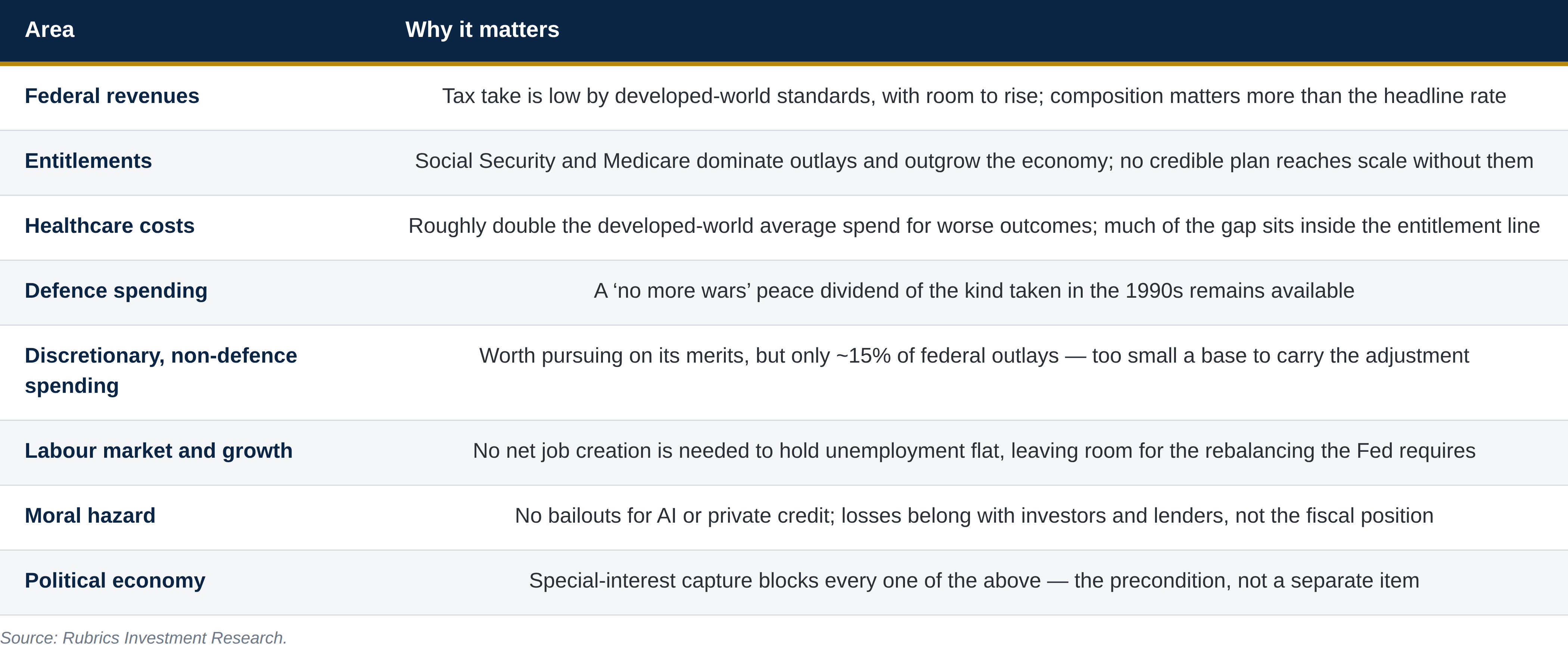
Taken together, these measures could bring rates down to a sustainable level of and generate real savings on deficit interest - without going anywhere near debasing the currency. The debt is deflationary, so a tightening of financial conditions would bring inflation down relatively quickly, meaning rate cuts could come sooner than many expect. The US does not need to destroy its economy to fix it. It needs its politicians to stop taking corporate money - and the gathering anti-oligarch mood, and the growing consensus that there will be no AI bailouts, may finally make that possible.
8. How We Manage This - Positioning
Expect the wrong answers first. Position for the volatility that produces, and for the reallocation that follows once the right answers are finally forced.
Our base case is straightforward and, we think, realistic: policymakers will exhaust the wrong options before they reach the right ones, and very little of substance will be attempted under the current administration. But the path is not hopeless. If Warsh does his job and wins the market’s confidence, if the Iran conflict fades quietly, and if the tariff agenda is retired after the midterms, that combination may be enough to keep the bond market content. The encouraging development is that the volatility and noise around the bond market are forcing the conversation that should have happened years ago and did not - because the Fed suppressed rates and removed the need for it. That conversation is now unavoidable, which is a genuine and healthy start.
The positioning that follows
— Hold positive real yields. A policy of positive real rates is the right foundation, and on that basis the US is currently the most attractive major market - unless Washington chooses debasement, in which case the calculus changes immediately and decisively.
— Maximise real yield across currencies. We run a global mandate, so the discipline is real-yield maximisation wherever the best risk-adjusted real return sits - with the important proviso that we require confidence there is no risk of the confiscation or forced conversion of bonds seen in the 1950s.
— Stay liquid and get paid for risk. Liquidity is a position in its own right in this environment. Risk assets and the AI bubble have looked dangerous for some time; the difference now is that policymakers are being forced awake just as the cracks appear.
— Back the team that eventually gets it right. We do not believe the US will ultimately choose to inflate the debt away. Inflation has already claimed one administration and may yet do so for another. The affordability debate is the bond market’s best friend.
OPPORTUNITY
There is a contrarian opportunity embedded in all of this. Much as Brexit made everyone else wary of leaving the EU, the first major economy to be seen debasing its way out of its debt would send capital fleeing that policy everywhere it appears - making disciplined, positive-real-yield markets the clear beneficiary. Any credible move toward fiscal discipline and monetary credibility builds the case; the requirement is simply that policymakers follow through. Encouragingly, even previously sceptical voices are now openly professing respect for the bond market - exactly the shift in tone that has to precede a shift in policy.
The through-line of this report is that the bill for thirty years of destructive policy is coming due, and that the payment, however uncomfortable, is the necessary precondition for a healthier allocation of capital. Today’s elevated asset valuations depend, in no small part, on the belief that the policy framework of the past three decades can be extended indefinitely. Yet a system that has delivered rising asset prices alongside widespread affordability pressures, weak productivity growth and increasing dependence on debt is becoming politically difficult to sustain. The market may want more of the same; the electorate increasingly does not. Our task between now and then is not to predict the precise sequence of policy errors, but to be positioned to withstand them and to buy the reallocation when it comes: liquid, high-quality, paid in real terms for every unit of risk, and patient enough to let the adjustment do its work.
Disclaimer: This communication and any attachments is confidential may contain personal information. It is intended for the addressee(s) only. Any unauthorised use, dissemination of the information, or unauthorised copying/forwarding of this message is prohibited. If you are not the intended addressee, please notify the sender immediately by return e-mail and delete this message. Any views expressed in this message are those of the individual sender, except where the message states otherwise and the sender is authorised to state them. Internet communications cannot be guaranteed to be secure or error free as information may be intercepted, corrupted, lost, arrive late or contain viruses. Rubrics Asset Management (Ireland) Limited is registered in Ireland (company number: 613956) and authorised and regulated by the Central Bank of Ireland in the conduct of financial services (reference number: C173854). Details about the extent of our authorisation and regulation is available on request. Rubrics Asset Management (Ireland) Limited does not accept liability for any errors, admission or losses which arise from this internet transmission. For more information about how and why we use personal information and who to contact with any queries about this, please see our privacy notice: https://rubricsam.com/legal/privacy-policy-2/.
Source: JP Morgan
Source: Forbes, Peter Cohan, August 19th 2026
Source: Nvidia press release August 10th 2026
Source: Financial Times Economics Show Podcast, June 2024
Source: IMF 2026 Article IV Consultation, Staff Concluding Statement for the United States