

Executive Summary
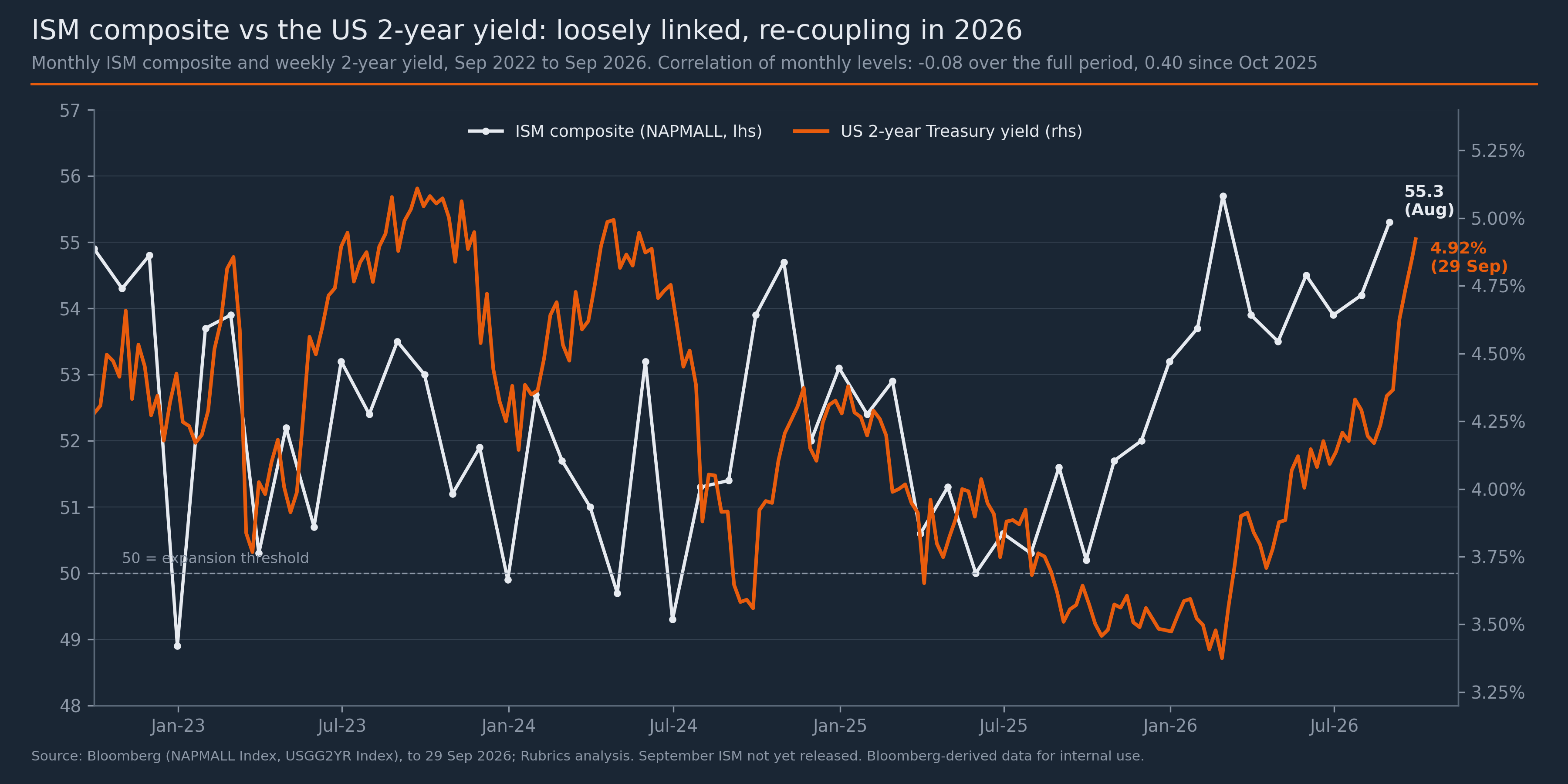
Beyond the noise surrounding AI, spanning excessive pessimism and blind optimism, the buildout is fundamentally re-shaping the economic and financial backdrop. Continued investment in AI infrastructure has been central to the recent strength in economic data. Combined with the inflationary effects of higher oil prices, it has underpinned Fed tightening and a 155bp rise in two-year Treasury yields since February 2026, exacerbating an already challenging K-shaped economic dynamic. AI’s influence is also visible in aggregate household wealth, a central driver of consumption, which has risen from (an already elevated) five to almost six times GDP since the introduction of Chat GPT in 20221. There is therefore a great deal riding on the success of this extraordinary buildout. At roughly $730bn–$850bn of capex in 20262 alone, and with $7–10tn of cumulative investment required by the early 2030s3, it is running at several times the peak economic intensity of the Manhattan Project or Apollo Space Programme. Yet unlike those projects, no government is paying for it. Five hyperscaler balance sheets underwrite it; private credit and bond markets increasingly fund it; and, at its edges, it rests on the promises of two cash-burning AI labs. To paraphrase Churchill’s famous quote – never have the fortunes of so many relied on the balance sheets of so few. The scale and importance of this buildout should not be underestimated, as given the already stretched levels of public finances globally, a major disappointment may be a lot harder to recover from.
Chart 1: The Inverted Pyramid
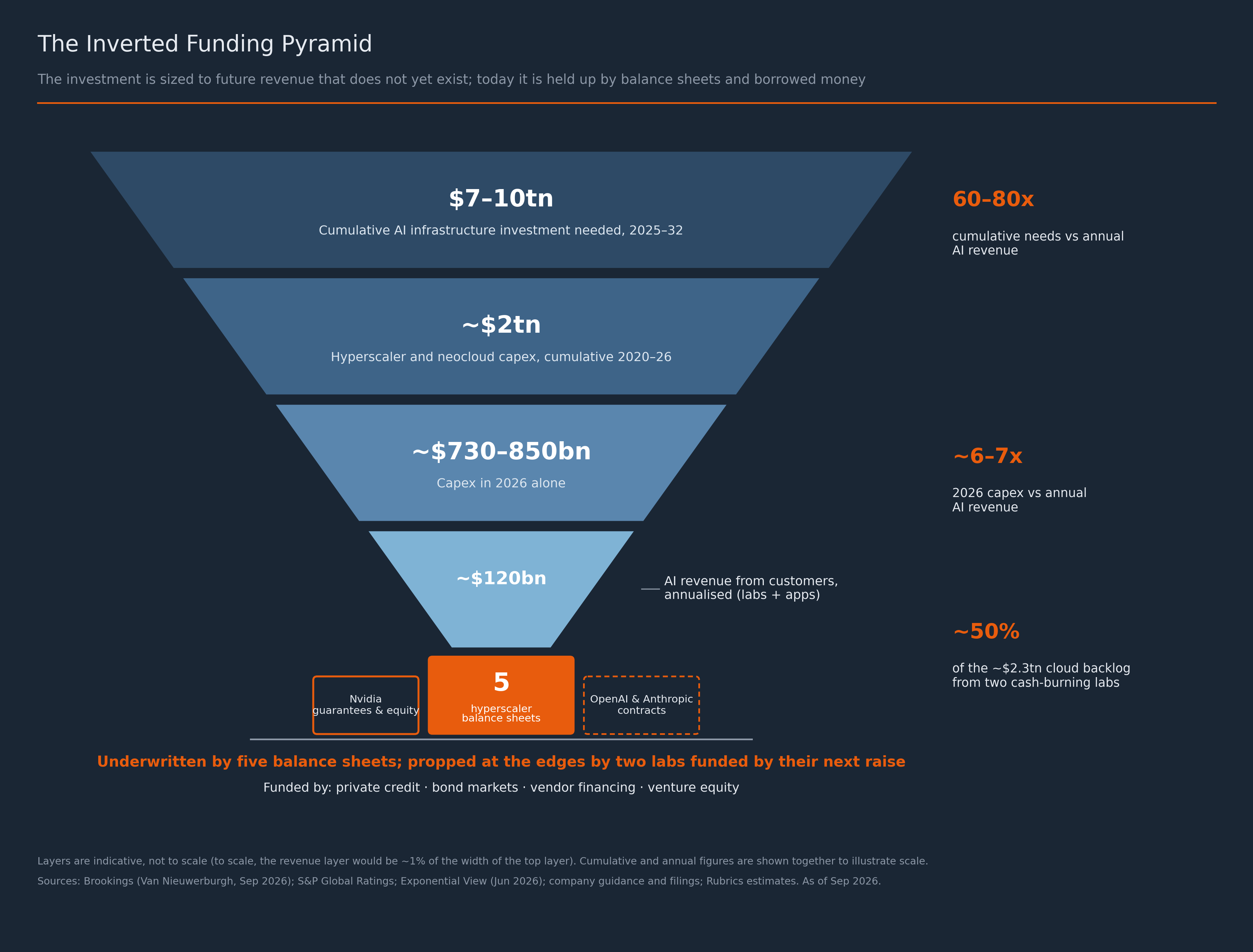
Sources: Brookings; S&P Global Ratings; Exponential View; company filings; Rubrics estimates.
This note is designed to highlight the fragility of the setup rather than forecasting imminent collapse. The technology is real, demand continues to grow and the hyperscalers remain among the strongest credits in the world. The vulnerability lies in the magnitude and complexity of the funding model: the breadth is narrower, more circular and more time-limited than the headline growth suggests. At the same time, ever-higher revenue is required to generate a return on invested capital, while supply constraints delay the capacity needed to earn it. The areas where this is most evident is on the financing side where cracks are already beginning to show.
1. The Scale of the Buildout and What It Rests On
Per the Brookings Institute, the scale of the full US data-centre buildout is estimated to hit an average of 3.6% of GDP a year over 2025–324. The unprecedented scale of this investment rests on just five companies - and on their willingness to keep deploying their pristine balance sheets. While historical projects of a similar scale were financed by one government through an appropriations process, this AI buildout is reliant upon a tangle of corporate bonds, leases, special-purpose vehicles, private credit, vendor guarantees and equity stakes that double as customer relationships.
For most of the cycle the hyperscalers funded this from cash flow. That is no longer true. On some estimates, capex across Microsoft, Alphabet, Amazon, Meta and Oracle exceeds their combined operating cash flow for the first time in 2026. Alphabet reported its first negative free-cash-flow quarter since its 2004 listing; Amazon’s trailing free cash flow has turned negative; Oracle burned $23.7bn in fiscal 20265. Microsoft is the one large spender still comfortably generating free cash flow. The gap is being borrowed.
The timing mismatch highlights the fragility of the AI investment complex. The buildout operates on two very different timescales. Suppliers of chips, memory, power equipment and construction services are paid upfront as capacity is built. The revenue needed to justify that spending, however, arrives gradually over many years as labs and enterprises purchase compute. Compute providers sit uncomfortably between these two timelines: they own the assets, carry the debt and execution risk, and rely on end-user demand materialising quickly enough to earn an adequate return on the investment.
Chart 2 - Timing Mismatch - Expenditure vs Payback
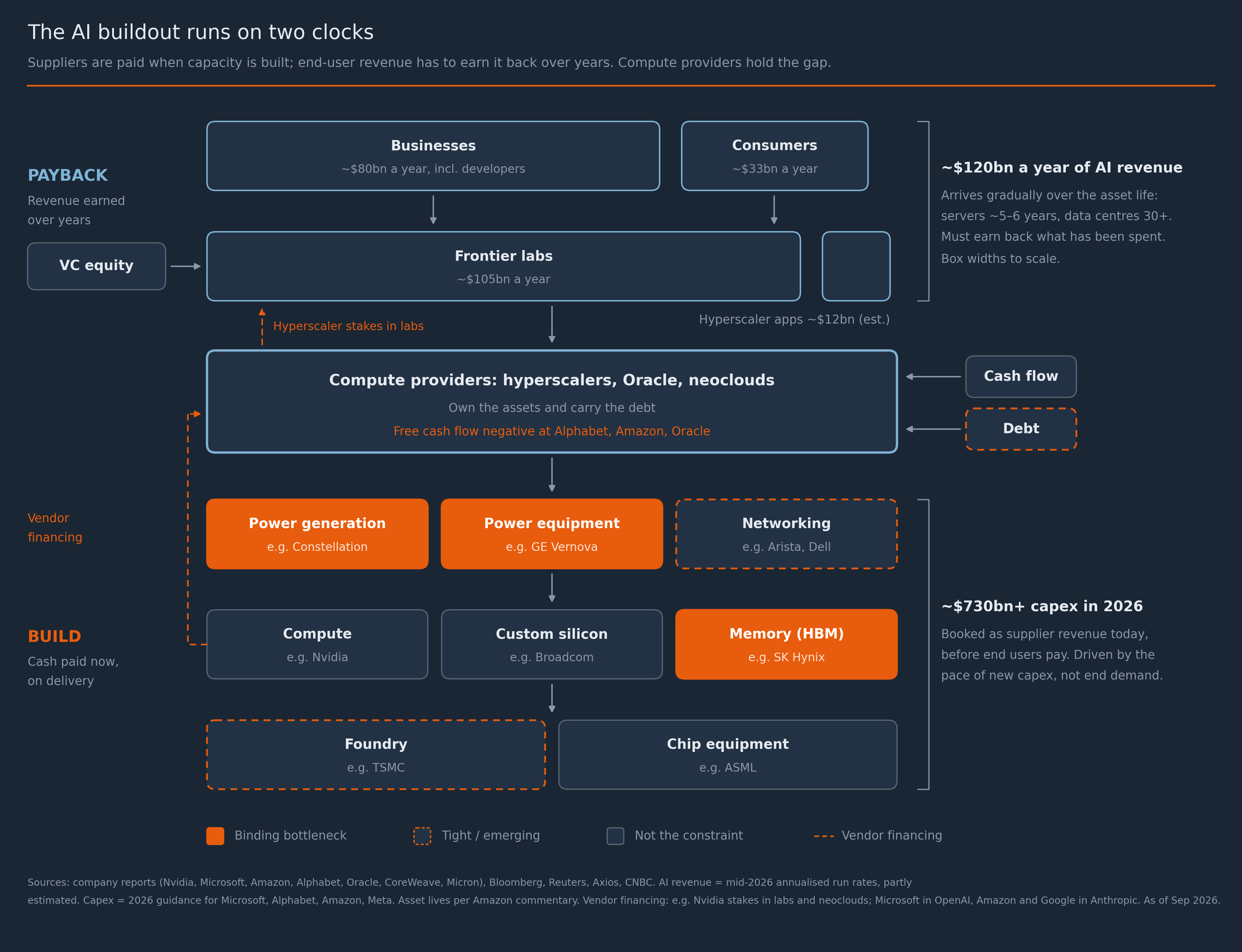
Sources: company reports; Bloomberg; press reporting; Rubrics analysis
2. Systemic Fragilities
a) Optimistic Revenue Expectations
AI revenue is real and growing quickly: labs and apps now earn about $120bn6 a year from customers, growing roughly 3x a year. The question is not whether revenue exists but how much has to arrive, in what timeframe, and on what terms for the significant capital commitments to earn a return.
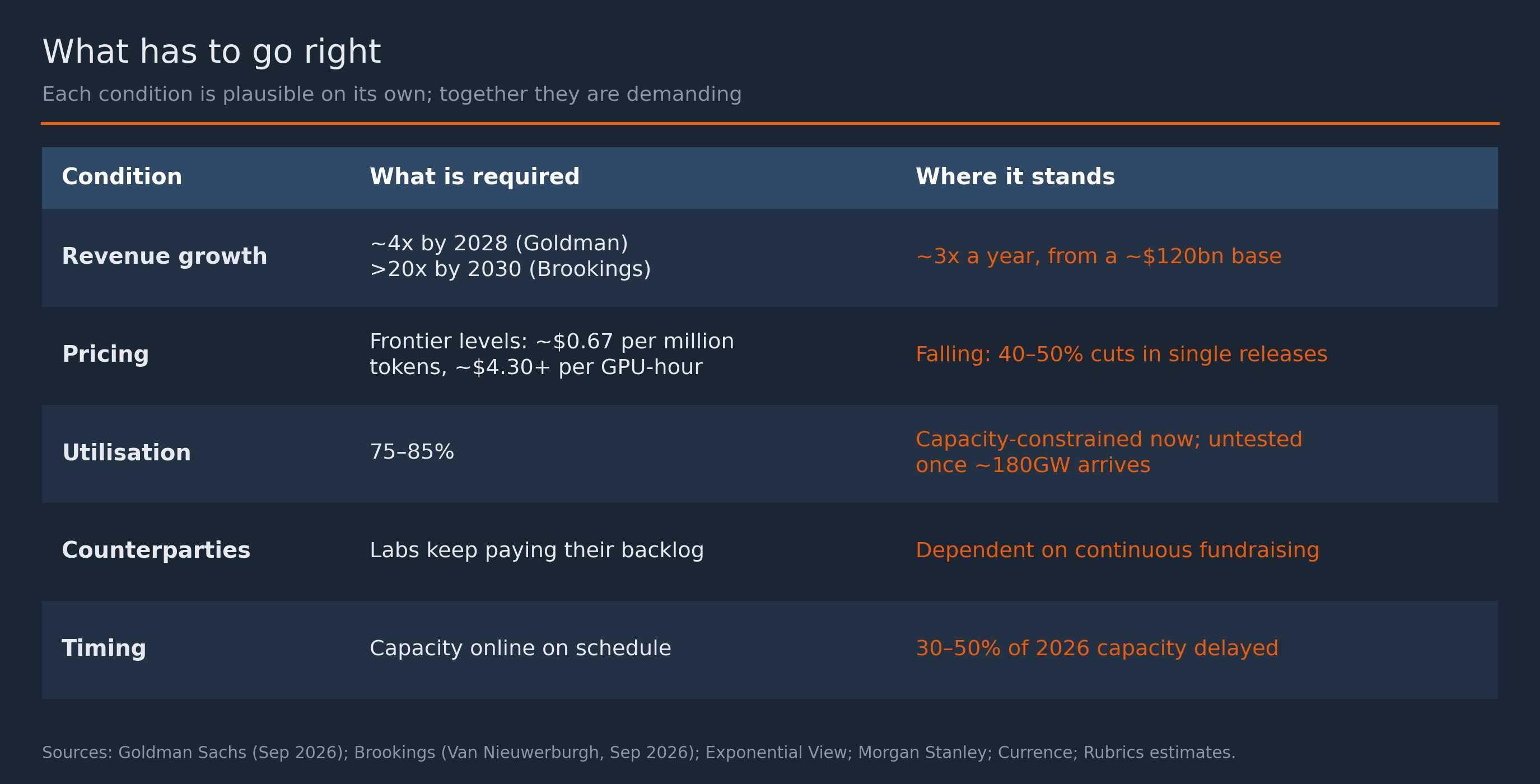
Goldman Sachs narrow estimate calculates that the six largest spenders need about $300bn a year to break even on their 2026–27 capex, and about $470bn a year over 2028–30 for a 15% return7. The Brookings Institute, looking at the entire US buildout at a 10% return, puts the requirement at about $2.7tn a year by 2030 and $3.7tn by 2032. Per dollar of capex, today’s revenue earns about $0.12 a year, against roughly $0.27 on Goldman’s hurdle and $0.44 on Brookings’ estimates. In short a significant leap is required.
Table 1 - Revenue Expectations
b) Pricing and Backlog Assumptions
In revenue terms, the investment case rests largely on two assumptions, both of which appear less robust than they first seem. The first is pricing. On Goldman’s framework, open-weight token prices imply a return of −11% to 6%, compared with 57–85% at frontier prices8. Yet the leading labs cut prices 40–50% in a single week in September9. Frontier-level economics depend on compute scarcity and are therefore likely to come under pressure just as new capacity comes online.
The second is backlog. Goldman estimates contracted demand covers 59% of the funding requirement. However, roughly half of the ~$2.3tn is owed by OpenAI and Anthropic10, whose ability to honour those commitments depends on continued access to external capital. Much of the backlog falls after 2030, is only lightly prepaid and remains open to renegotiation.11 What is often presented as a cushion against financing risk may be the financing risk itself.
c) Supply side Bottlenecks
The buildout is increasingly constrained by physical supply rather than demand. Grid access, power equipment, memory, foundry capacity, permits and local consent are all binding: an estimated 30–50% of 2026 capacity may be delayed, while only 6.3GW is under construction for 2027 against 21.5GW announced. Scarcity supports prices but creates three risks. First, delays leave capital committed while revenue waits, ageing short-lived hardware as interest accrues. Second, margin shifts to whoever controls the bottleneck: memory’s share of build cost has risen from about 2% to 18%, squeezing returns elsewhere. Third, today’s scarcity-based pricing may erode just as capacity arrives and depreciation accelerates. Efficiency gains have so far deferred rather than destroyed revenue, with token volumes growing about 14x a year. The risk is timing: if delays become cancellations or efficiency gains stall, the constraint supporting prices could instead strand capital.12
d) Opaque Financing Architecture
With cash flow no longer covering capex, the gap is being filled through structures that move risk off the spenders’ balance sheets and out to other investors. Together, they form a financing architecture whose closest precedents are the telecom boom of the late 1990s and GE Capital’s vendor lending:
Off balance sheet. The big four carry about $2.4tn of obligations that sit outside reported debt: $904bn of future leases and $1.52tn of purchase commitments, mostly chips (Wall Street Journal analysis, cited by Brookings). Meta’s $30bn Hyperion campus is the template: a joint venture with Blue Owl, funded about 90% with debt, with Meta holding short renewable leases and a residual value guarantee that do not appear as debt under GAAP. Meta accepted borrowing costs about 100bp above its own bonds to keep it that way.
Securitised and private. Data-centre ABS and CMBS have grown from $4bn in 2020 to $61bn so far in 2026, and loans are now being pooled and sold on to asset managers and pension funds. Private credit to AI companies exceeds $200bn (BIS), largely unrated and infrequently marked.
Vendor financing. Nvidia has become a financier of its own demand: equity stakes in its customers, a $36bn commitment to rent back unused neocloud capacity, $108.5bn of disclosed guarantees (including up to $105bn on SB Energy’s Ohio campus leased to OpenAI), and $500bn of non-binding memoranda with six asset managers to fund GPU purchases. The hyperscalers do the same one step up, holding equity in the labs whose spending returns to them as cloud revenue13.
Circularity. The clearest example is a single chain: SoftBank borrows at close to 10% to fund OpenAI, which leases SB Energy’s campus, which Nvidia guarantees and fills with Nvidia chips. Each link is financed partly by the next. That is how telecom equipment makers financed their own customers before 2001, and how GE Capital’s balance sheet amplified GE’s downturn: the structures work while the whole chain is growing, and transmit stress in both directions when it stops.
Chart 3 - Circular Financing
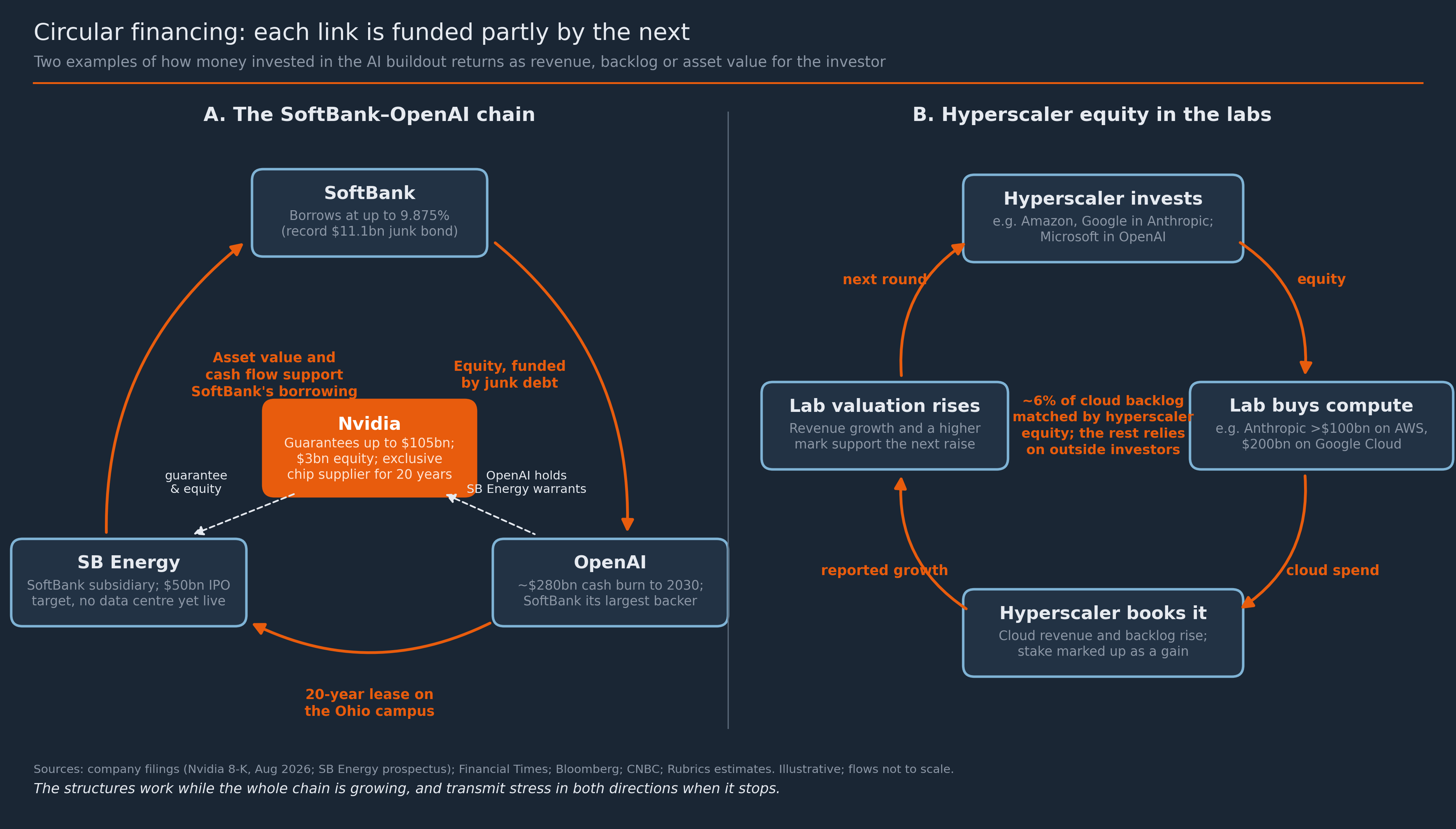
Sources: company filings; Financial Times; Bloomberg; CNBC; Rubrics estimates.
One difference from those precedents is genuine and cuts both ways. Today’s anchors are far stronger: the hyperscalers have real revenues and some of the best balance sheets in the world, which is why the structure has been able to grow thus far. But that also means the risk has migrated into instruments held as ordinary investment-grade paper, securitised notes and private credit, by investors who may not realise they are underwriting AI infrastructure.
3. The Strain Is Visible - Financing
What the market has already priced
The buildout runs on two clocks, and markets have rewarded those paid on delivery. Memory stocks are up about 234% this year, networking and servers 197%, custom silicon 93%, Nvidia and AMD 89%, and chip equipment 63%. Scarcity has shifted margin to key inputs: memory’s share of data-centre build cost has risen from about 2% in 2021 to 18% in 2026. By contrast, the five spenders are flat against a 10% rise in the S&P 500, while CoreWeave is down 31% since June and power generators 21%. Even suppliers are priced for a peak: their relative multiple has fallen as estimates outpaced prices, with Nvidia below 17x forward earnings. In other words the market is paying for today’s cash and doubting tomorrow’s.14
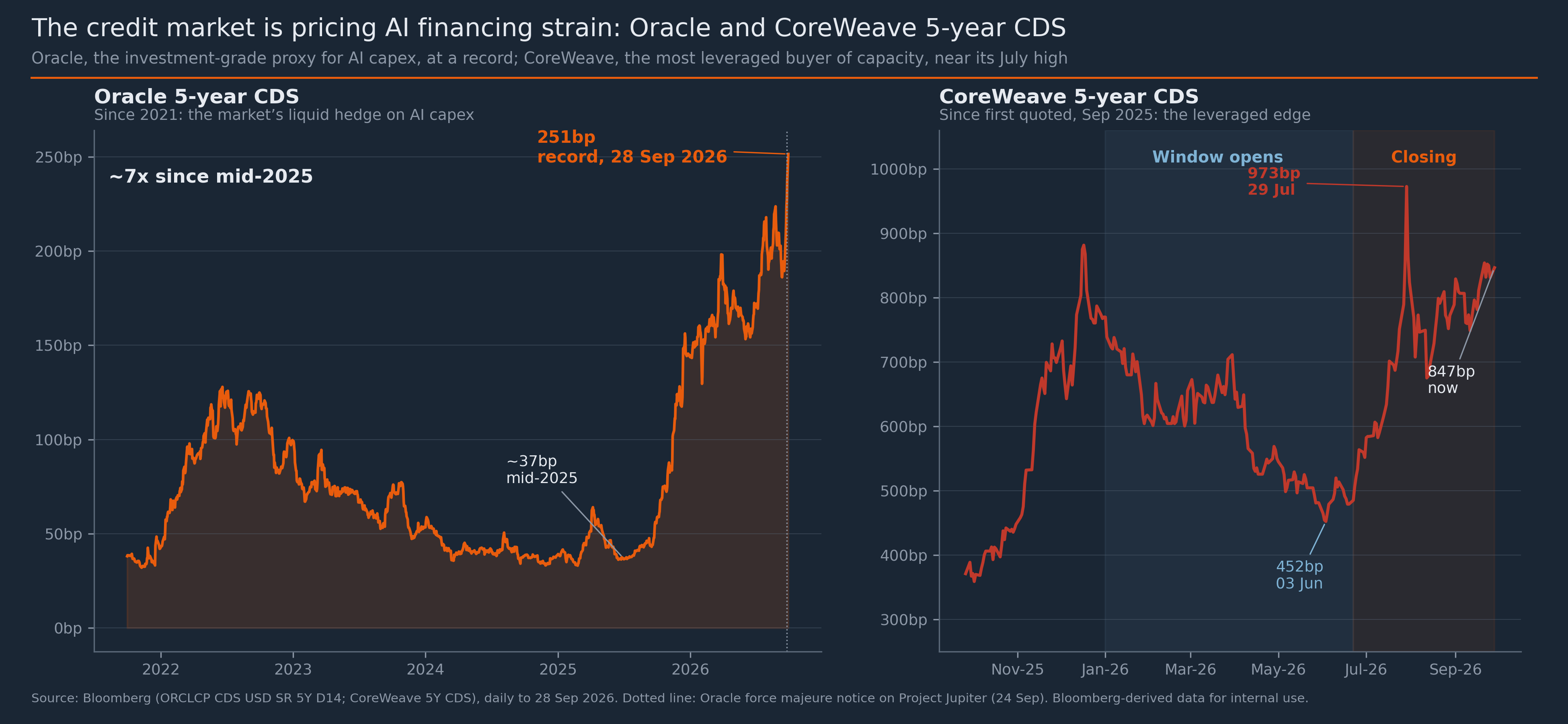
Chart 4 - Financing Strain
Source: Bloomberg, 28/09/26
Six markets, one signal
The case for fragility does not rest on any single indicator, but rather several separate channels, each with their own instruments and investors, repricing the same underlying exposure within roughly twelve months.
Credit derivatives. Oracle’s five-year CDS reached a record 250bp on 29 September, nearly a week after its force majeure notice became public, and it now trades as the market’s liquid hedge on AI capex as a whole. The widening has spread inwards: Meta at about 101bp, Amazon and Alphabet at about 72bp and 73bp, and Microsoft, through a newly traded contract, at about 52bp. All started widening in late June, peaked in late July and widened again in September, while the broad investment-grade index tightened. The premium is specific to AI.
The IPO market. SB Energy, Holtec and Aggreko delayed or paused listings within weeks of each other in September, from a pipeline in which data-centre companies were expected to supply about a third of remaining 2026 IPOs. OpenAI’s listing has slipped towards 2027. When SB Energy’s listing stalled, Nvidia added $1.5bn to its stake: the vendor stepping in where the public market would not.
Non-dollar bonds. The non-dollar share of hyperscaler issuance has doubled to about 30%, with record deals in euros, sterling, yen, Swiss francs and Canadian dollars and a technology century bond. The ECB has warned of crowding out European borrowers. Investors outside the US now hold AI capex exposure inside their domestic corporate bond indices.
Structured credit. Data-centre securitisation has grown fifteenfold in six years, and lenders have begun re-securitising their data-centre loans to pension funds and insurers.
High yield. SoftBank’s $11.1bn bond, the largest corporate junk deal on record, priced at up to 9.875% to fund further investment in OpenAI. Its leverage limits are tied to asset values, so any fall in AI sentiment feeds straight back into its borrowing capacity.
Financial innovation. Nvidia’s guarantees, its capacity backstop, the $500bn of memoranda and exchange-traded compute futures launching on 5 October are new instruments built to finance what conventional lenders would not.
The most compact summary of all six is the price of the guarantee. CoreWeave borrowed at 5.9% in March on GPU debt backed by a Meta contract; its own unsecured 2032 bond now yields about 13%15. Part of that gap reflects seniority and timing, but most of it is the market’s measure of how much of the buildout cannot stand on its own credit. Balance matters here. SoftBank’s junk bond drew more than $20bn of orders, and the broad credit market remains calm. Demand for AI paper exists, but increasingly only at a price, and only where a strong balance sheet stands behind it.
4. How It Unravels
The most likely path to trouble is not a sudden collapse in demand. Most indicators continue to rise, and the hyperscalers still describe themselves as capacity-constrained. The more immediate risk lies in the financing channel. Because a considerable share of the buildout has been funded through private credit, AI-related borrowing has so far been less responsive to Fed tightening than the wider economy. That divergence cannot persist indefinitely. As government yields rise, more attractively priced sovereign bonds may crowd out competing investments and raise the return required on private capital. Revenue deferrals, renegotiation of compute backlogs or further delays in bringing capacity online would intensify that pressure. Leveraged neoclouds and Oracle are the clearest bellwethers.
A disorderly tightening in AI financing could therefore become one of the most consequential risks to the global economy. The buildout has supported consumption through the wealth effect while also providing substantial momentum to real investment. A marked slowdown would remove both supports at a time when the weaker half of the K-shaped economy is already under pressure, increasing the risk of recession and prompting a Federal Reserve response well beyond the pre-emptive cuts delivered by the Powell Fed in 2024.
Chart 5 - AI Driven Economic Acceleration vs Tightening US Rates
Source: Bloomberg, 28/09/26
5. What It Means for Portfolios
The conclusion is not to short the theme or call the top. The buildout continues for as long as a handful of boards keep raising capex guidance, and that willingness has not broken. The task is to hold the exposure deliberately and in known size.
● Select credits rather than own the sector. Differentiate between the cash-funded spenders, led by Microsoft, and the names already showing speculative characteristics: Oracle and the listed neoclouds. Oracle’s CDS is the most liquid hedge on the theme.
● Look through benchmarks. Long-dated hyperscaler bonds sit inside investment-grade indices, including non-dollar indices, and data-centre exposure sits inside securitised and private credit vehicles. Headline ratings lag market-implied risk.
● Watch Financial Conditions. Meaningful tightening in conditions on a growth slowdown can see a swift repricing of broader risk assets. Favour liquidity in this environment
6. Signposts and Conclusion: It Will Be the Conditions, Not the Incident
Bear Stearns failed in March 2008 into a system that still had balance-sheet capacity. JPMorgan absorbed the assets, the Fed backstopped the rest, and the machinery kept running. Lehman failed six months later into a system that had quietly exhausted much of its ability to absorb further stress. Lehman is remembered as the cause. In reality, it was the catalyst. The underlying conditions had been deteriorating in funding markets for most of a year.
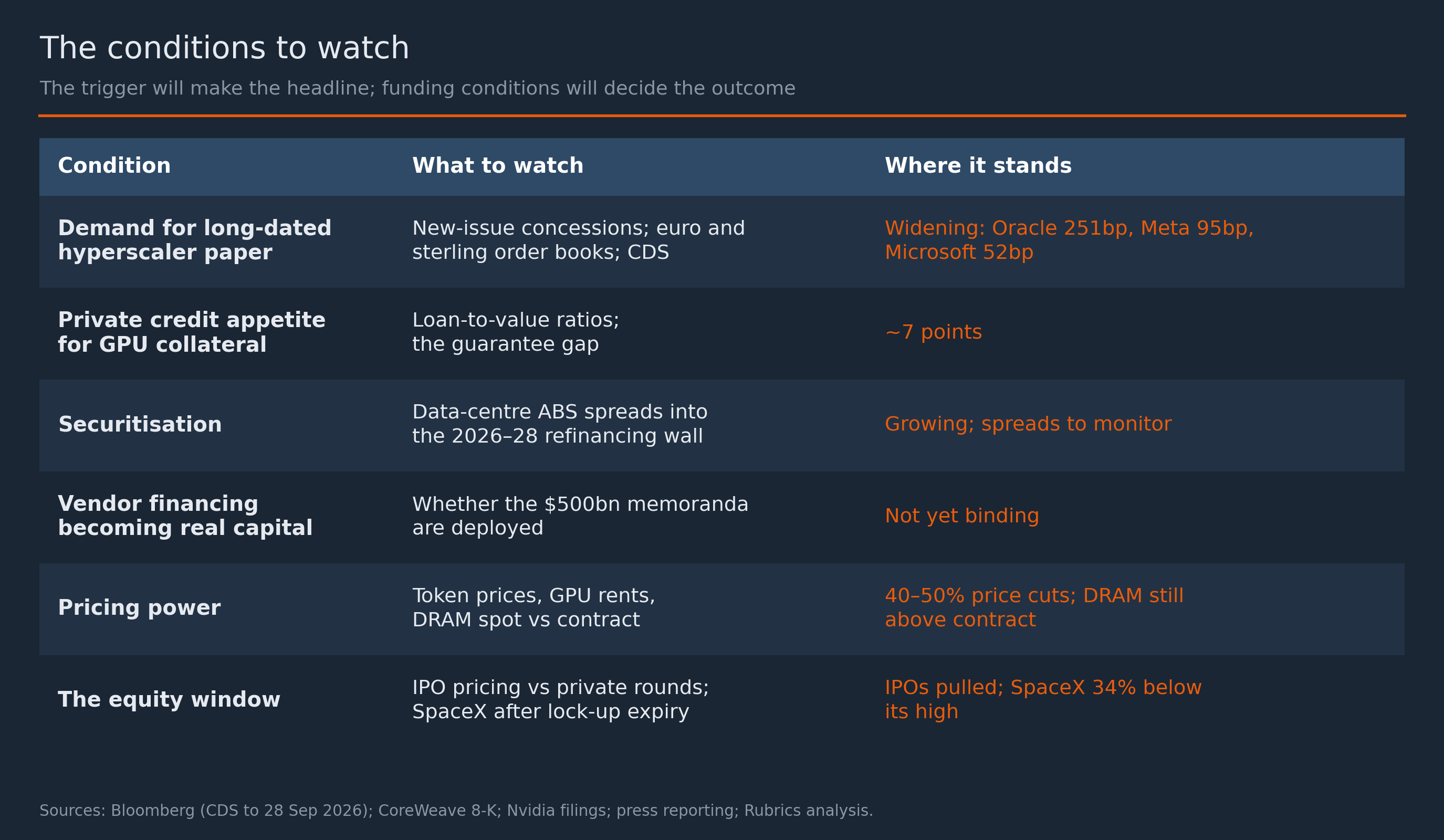
The same structure may apply here. If a tipping point emerges, the trigger will probably be easy to identify: a debt issue that struggles to clear, a neocloud missing a payment, an AI IPO pricing below its last private round, another force-majeure notice. That will be the headline. The outcome, however, will be determined not by the trigger itself but by the state of funding conditions when it arrives:
Table 2 - Conditions to Watch For
From a macroeconomic perspective, the AI build-out, financed largely by five exceptionally strong corporate balance sheets, has been both a blessing and a a source of distortion. It has generated significant economic activity in sectors that previously attracted little private investment, while also creating supply bottlenecks and inflationary pressures across semiconductors, power infrastructure, construction and related supply chains. Its broadest impact may have been the wealth effect it has generated, even if those gains have accrued to a relatively narrow group of companies and households.
Yet the same process may also be revealing deeper vulnerabilities within the US economy. If today’s funding strains evolve into a more meaningful slowdown, the economy could be poorly positioned to absorb the resulting second-order effects. AI investment has become an increasingly important source of growth, income and market performance, leaving both the economy and financial markets exposed to an unproven frontier-model thesis supported by an increasingly complex funding structure. Markets appear to be pricing economic returns that may not materialise within the required timeframe, a pattern that has accompanied many previous technological revolutions.
Disclaimer: This communication and any attachments is confidential may contain personal information. It is intended for the addressee(s) only. Any unauthorised use, dissemination of the information, or unauthorised copying/forwarding of this message is prohibited. If you are not the intended addressee, please notify the sender immediately by return e-mail and delete this message. Any views expressed in this message are those of the individual sender, except where the message states otherwise and the sender is authorised to state them. Internet communications cannot be guaranteed to be secure or error free as information may be intercepted, corrupted, lost, arrive late or contain viruses. Rubrics Asset Management (Ireland) Limited is registered in Ireland (company number: 613956) and authorised and regulated by the Central Bank of Ireland in the conduct of financial services (reference number: C173854). Details about the extent of our authorisation and regulation is available on request. Rubrics Asset Management (Ireland) Limited does not accept liability for any errors, admission or losses which arise from this internet transmission. For more information about how and why we use personal information and who to contact with any queries about this, please see our privacy notice: https://rubricsam.com/legal/privacy-policy-2/.
Source: Bloomberg as at 30/06/26
Source: Company Guidance (Total Capex)
Source: S&P Global Ratings (lower bound) Brookings Institute (Van Nieuwerburgh) (upper bound)
Source: Financing the AI buildout | Brookings
Source: Oracle full fiscal year 2026 result June 10 2026
Source: Rubrics based on analysis from Exponential View
Source: Goldman Sachs, https://allweatherfinance.com/ai-capital-expenditures-are-approaching-1-7-trillion-what-level-of-return-would-be-considered-reasonable-goldman-sachs-has-done-the-math/
Source: Rubrics analysis of Goldman framework
Source: CNBC 22 September 2026
Source: https://cloudwars.com/cloud-wars-minute/microsoft-oracle-google-aws-2-3-trillion-backlog-rpo/
Source: Do OpenAI and Anthropic really make 70% of Hyperscalers' growth?
Sources: Currence (data-centre delay estimates, 2026); press reporting on US data-centre construction pipelines (Sep 2026); Exponential View, The State of the AI Economy (Jun 2026), citing Goldman Sachs, Epoch AI and SemiAnalysis (memory's share of build cost; token volumes); company filings; Rubrics analysis.
Sources: Nvidia Form 8-K and Form 10-Q (August 2026); SB Energy IPO prospectus; Financial Times; Van Nieuwerburgh, Brookings conference draft (September 2026); hyperscaler filings and press reporting (CNBC) on investments in OpenAI and Anthropic.
Source: Bloomberg as at 23/09/26
Source: Bloomberg as at 23/09/26