

On 17 June 2026, Kevin Warsh chaired his first FOMC meeting. He held rates at 3.50–3.75%, cut the policy statement to 130 words, withheld his own dot, and launched five task forces. Beneath the procedural detail sits something larger: a deliberate attempt to shrink the Fed’s footprint in markets and restore the central bank to a narrower, humbler role.
This report sets out what Warsh is trying to do differently, why Rubrics believes the direction of travel is correct - even healthy - and why the timing is treacherous. Our central contention is that the post-Greenspan Fed made an active choice to manage the economy through markets (wealth effect) with words and liquidity, and in doing so became hostage to the very markets it was meant to discipline. Warsh proposes to reverse that. We are cautiously hopeful. But he inherits the largest asset bubble of the modern era and a world in which the Great Moderation - the backdrop that made activist forward guidance look costless - is over.
The Rubrics view in one line: A smaller, quieter, less predictable Fed is the right destination and a powerful antidote to moral hazard and misallocation of capital. But every Chair since Greenspan has talked this language out of power and reflated bubbles once in it. The test is not Warsh’s words in June 2026, it is whether he holds the line when the first serious drawdown arrives.
1. The Man: Why Warsh left the Fed, and what he says he learned
Kevin Warsh is not a conventional appointment. Nominated to the Board by George W. Bush in 2006 at just 35 , the youngest governor in history, he was the Fed’s liaison to Wall Street through the 2008 crisis, working alongside Bernanke and Geithner on Bear Stearns, Lehman and AIG. He voted for the emergency QE of 2008–09 but then watched what came next and concluded the Fed had mistaken an emergency tool for a permanent one.
In a 2010 Wall Street Journal op-ed he warned that QE2 was ‘limited, circumscribed and subject to regular review’ - and when the Committee pressed on regardless, he resigned in March 2011, seven years before his term expired. His stated objection: the asset-buying programme left the central bank ‘too deeply entrenched in the U.S. economy’, misallocated capital, and favoured large wealth-holders over the small and medium businesses that actually drive employment. He was also concerned around the inflationary impact loose financial conditions would bring; while he was at the time incorrect on CPI, he was on the money on asset price inflation. This is the intellectual spine of everything he says he is going to do as Chair.
The views he carried back in
▪ Mission creep: that the Fed suffers from ‘mission creep’ and should refocus first and foremost on price stability;
▪ Moral hazard: that QE should have been wound down once the 2008 emergency passed, and that leaving QE1 in the system then layering QE2 on top ‘laid the groundwork’ for the inflation that followed;
▪ Market discipline: that the Fed neglects ‘market discipline’ — it jumps in at any sign of trouble, producing an economy weaker than it should be;
▪ Status quo: that, channelling his old mentor Milton Friedman, the real danger is the ‘tyranny of the status quo’ — a critique he now turns on the institution itself.
2. The First Meeting: What Actually Changed
The 17 June decision was, on rates, a non-event — a unanimous hold. The signal was in the staging. Five concrete departures from the Powell template stood out:

Source: CNBC, ‘Five big takeaways from Warsh’s first meeting’ (17 Jun 2026); Federal Reserve press-conference transcript (17 Jun 2026); Chase/J.P. Morgan FOMC note.
The Five Task Forces: Mechanism of Reform
At his first meeting (17 June 2026), Warsh launched five task forces - each pairing internal Fed staff with outside experts, with a common charge: ‘start with first principles, ask hard questions, examine current practice, consider alternatives, and propose next steps.’ They are the mechanism of his reform: rather than impose change, he builds consensus through review. Several reports are expected by year-end.
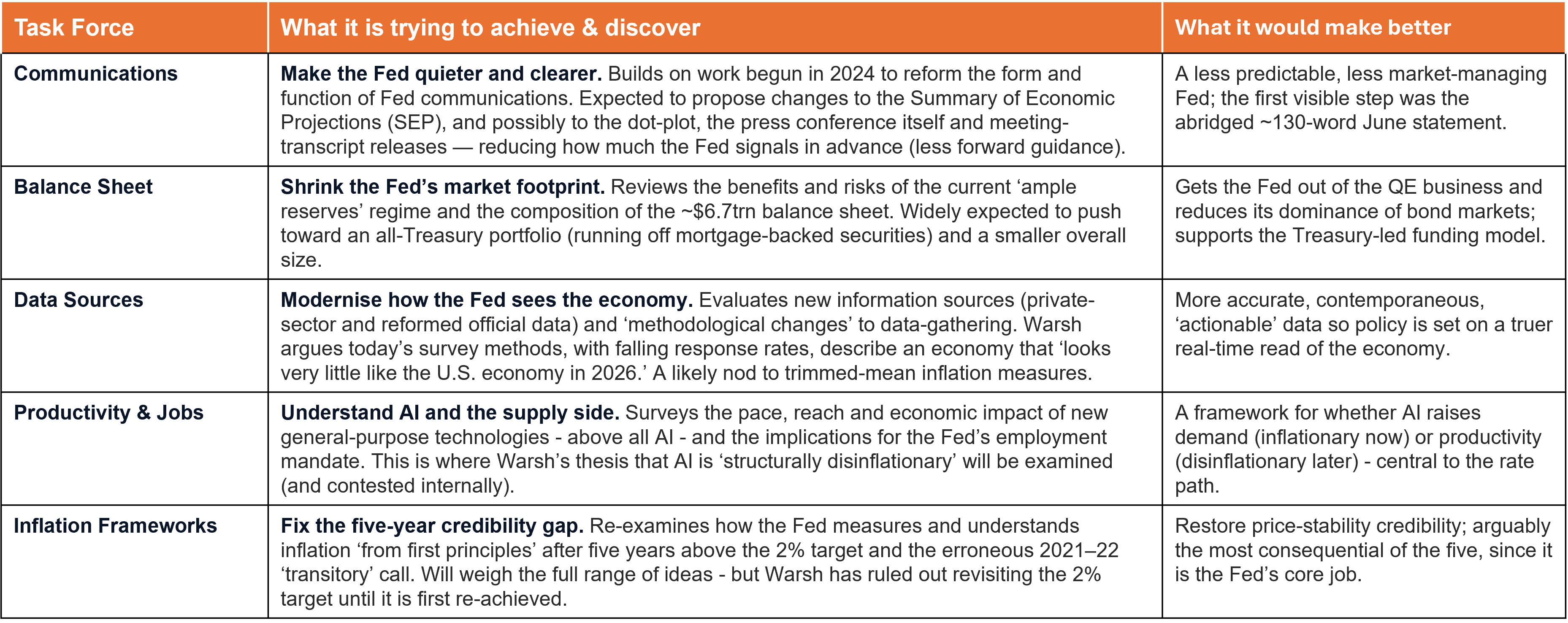
Source: Federal Reserve press-conference transcript (17 Jun 2026, via MaceNews/TradingView); CNBC; American Banker; Washington Examiner; Briefs.co. Balance sheet ~$6.7trn at peak.
Note the deliberate informational scarcity. Markets entered the meeting, in CNBC’s phrase, ‘with almost no idea what he thinks’ - and that was by design. He used the term ‘price stability’ on roughly a dozen occasions. The dot-plot split 9–9 between hold/cut and hike, with the median pointing to a quarter-point increase - and the nineteenth voter, Warsh, simply declined to show his hand.
Why this matters: Powell’s 2022 trap is the cautionary tale. Having guided markets toward easy policy through 2021, he was reluctant to reverse quickly for fear of ‘letting markets down’ against his own prior communications - and the Fed fell behind the inflation curve. Warsh’s answer is to stop pre-committing. As he put it: if the Fed waits until it is in the meeting to decide, ‘that incremental deliberation can keep the central bank from compounding its errors.’
The potential upshot is a Fed that is quieter (communications), smaller in markets (balance sheet), better-informed (data), clearer on the supply side (productivity/AI), and above all credible on inflation. As one strategist put it, this is ‘regime change, but in a velvet glove’ - a comprehensive rethink delivered through consensus rather than confrontation.
3. The Big Idea: Reclaiming Price Discovery from the Fed
The deepest of Warsh’s ambitions is also the most under-reported. He wants asset prices to become a communication tool again — a signal generated by the market — rather than merely a reflection of the Fed’s own stance. In a world of standing forward guidance and a $6.7trn balance sheet, prices have increasingly told you what the Fed will do, not what the economy is worth. That is the death of price discovery, and the root of serial mispricing.
Mervyn King, in his book The End of Alchemy, made the point that this was not destiny but choice: policymakers actively elected to manage expectations through ever-richer communication. Rubrics’ contention is that the fear of an unknown, discretionary Fed is a far more powerful disciplining tool than a fully-telegraphed one — and crucially, it is the antidote to the moral hazard the Fed itself created. A central bank that will not tell you it has your back forces investors to price risk themselves. The ‘Fed put’ only works because it is advertised.
This is the heart of the regime change: the relationship has been inverted. The Fed was meant to discipline markets; instead it became hostage to them, unable to tighten or shrink its balance sheet without first negotiating with the very asset prices it had inflated. Warsh wants the Fed out of that trap — narrower mandate, smaller balance sheet, quieter voice, and markets that once again do the work of valuation.
The Volcker question: Every Chair since has wanted to be the next Volcker — the man who broke inflation by being willing to inflict pain and ignore the howls. None has been. Warsh’s withholding of his dot and his refusal to pre-commit are, in spirit, the most Volcker-like opening moves we have seen. Whether they survive contact with a falling market is the entire question.
4. The Pattern Warsh is Reacting Against: A Fed that Talked, then Folded
Rubrics’ scepticism of central-bank rhetoric is earned. The recent record is one of governors articulating sound doctrine and then doing the opposite under pressure:
▪ Powell, on QE: In 2012 he argued the release of the iPhone 5 would do more for the economy than QE - a pointed dismissal of the Fed’s self-importance. He then presided, as Chair, over one of the largest expansions of the money supply in Fed history, and missed the 2% inflation target for five years and counting.
▪ Powell, on limits: In a 2019 speech he declared monetary policy had reached its limits — only to unleash, the following year, a balance-sheet expansion of historic scale.
▪ Average inflation targeting: Powell’s 2020 ‘average inflation targeting’ - the idea that after a period below target, a period above target is acceptable - was quietly abandoned almost as soon as inflation arrived. In August 2025 the framework was formally walked back . Doctrine discarded the moment it became inconvenient.
The central theme is inconsistency: frameworks adopted in calm and jettisoned in stress. This is exactly the credibility deficit Warsh diagnoses - and exactly why his project is necessary. It is also why we withhold full conviction: the failure mode is not the diagnosis but the follow-through.
5. Where We Think He Is Wrong: AI, Productivity and ‘Structural Disinflation’
Warsh’s one genuinely dovish instinct is his belief that AI-driven productivity justifies lower rates. He has called the AI boom ‘the most productivity-enhancing wave of our lifetimes’ and described it as ‘structurally disinflationary’, opening the door to letting the economy run hot. Rubrics regards this as the weakest link in his framework, and the place where the old reflationary temptation could re-enter through the back door.
The error is one of timing and direction. Over a long horizon, genuine productivity gains are disinflationary - more output per input lowers unit costs. But the demand impact of AI right now is the opposite: a capital-spending supercycle of historic scale. Hyperscaler capex is consuming, not releasing, resources - power, chips, construction, skilled labour, copper. The near-term AI impulse is inflationary, bidding up the price of everything its build-out touches. To cut rates today on a disinflation that is years away is to repeat the precise error of pre-committing to a forecast - the very sin Warsh built his reputation criticising.
Notably, he is not unopposed inside the building: Governor Michael Barr has said he expects the AI boom is ‘unlikely to be a reason for lowering policy rates, while the data suggests the inflation side of the mandate is already running hot. A Chair who built his name on inflation-fighting credibility cutting into an AI-capex-driven demand boom would be a contradiction the market would punish.
6. Getting Out of the QE Business: Warsh and the Treasury
A quieter but structurally important strand is Warsh’s desire to shrink the Fed’s $6.7trn balance sheet and get the central bank out of the business of standing in markets. He has been explicit that the balance sheet gives the Fed ‘too much presence in financial markets.’ The logical corollary - and the direction Rubrics expects - is a re-division of labour with the Treasury: fiscal authorities own debt management and any large-scale market intervention, while the Fed retreats to its narrower monetary remit.
This matters because QE blurred the line between monetary and fiscal policy. When the Fed buys trillions in government debt, it is financing the Treasury and managing the yield curve - inherently political acts that compromise independence and entrench moral hazard. Pushing balance-sheet and debt-management responsibility back to Treasury would let the Fed reclaim a purer role. The signal, as ever, may matter more than the mechanics: a Fed visibly committed to shrinking its market footprint changes how investors price duration and risk.
One of the greatest challenges lies in the fact that the Fed is withdrawing from bond markets - shrinking a balance sheet that at its peak absorbed the majority of net Treasury issuance - at precisely the moment fiscal deficits have become structural rather than cyclical. Under Warsh's regime there will be a much heavier reliance on private investors to provide funding, at a price the market sets, not one the Fed manages. In this environment the Fed's credibility is paramount - without it, the term premium, and with it the cost of funding for both government and the private sector, moves materially higher. There is also a beneficial side-effect : with the central bank no longer suppressing the cost of debt, governments that mistook a decade of near-zero rates for permanent fiscal licence would once again face a market that disciplines profligacy - a constraint the QE era quietly removed.
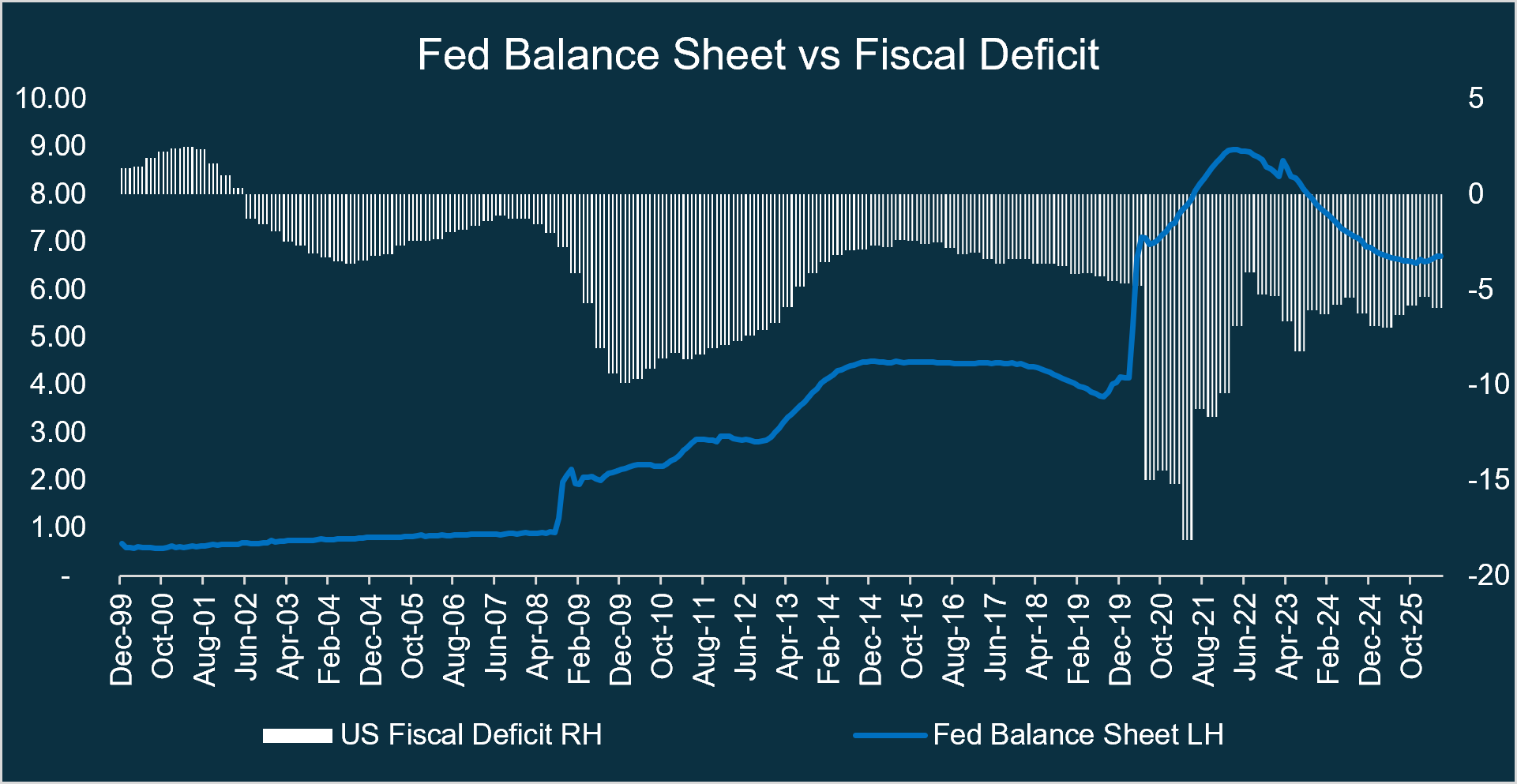
Source: Bloomberg as at 31/05/26
7. Inflation; The dual mandate and the ‘cruel choice’ Warsh rejects
Warsh takes the chair with inflation above the Fed’s 2% target for more than five years - the defining failure of the Powell era and the credibility wound that frames everything he says. He is blunt: restoring price stability is “an important message we’ve missed for five years” and the commitment to deliver is “strong, unanimous, and unambiguous.” The backdrop is hard: headline CPI hit 4.2% in May (a three-year high, energy-led after the Iran shock), with core at 2.9% but falling month-on-month.
The trade-off he denies
The most revealing thing Warsh said was not about rates but about the mandate itself. Pressed on employment, he rejected the classic trade-off: “I don’t believe that we have a cruel choice … If we do our job, we can make strong growth, low prices, and strong employment mutually compatible.” This is a real break from the Phillips-curve view that jobs and inflation must be balanced one against the other. His claim is that price stability is the precondition for durable employment, not its enemy - anchor prices, and the supposed trade-off largely dissolves.
He frames inflation precisely: the Fed cannot move relative prices — oil, beef, eggs — but must stop a shock “broadening” into general expectations. That is the basis for holding in June rather than hiking into an energy spike: watch whether the shock stays in headline or bleeds into core. A fifth task force will study inflation’s drivers “from first principles,” though he won’t revisit the 2% target until it is first re-achieved.
Warsh’s organising principle is that ‘credibility is earned by delivering.’ It is also his vulnerability. At the June meeting a Wall Street Journal reporter pressed the obvious point: if credibility requires delivering, and inflation is at a three-year high, why not tighten now - or at least threaten to? Warsh’s answer was that no one of the nineteen people around the table had reached that judgement, and that he had ‘nothing more to say than the statement itself.’ This is the live tension in his inflation stance, and it connects to the deeper irony Rubrics has flagged elsewhere: Warsh arrived associated with a desire to cut rates (on his AI-productivity thesis), yet the conditions he inherits point toward a hike.
8. Is He Really More Volcker? The Chairs Since Greenspan
The recurring fantasy of every modern Chair is to be Volcker - disciplined, independent, willing to absorb political and market pain to defend the currency. The reality has been a drift toward an ever-larger, ever-more-communicative, ever-more-indispensable Fed. The table assesses where Warsh sits.
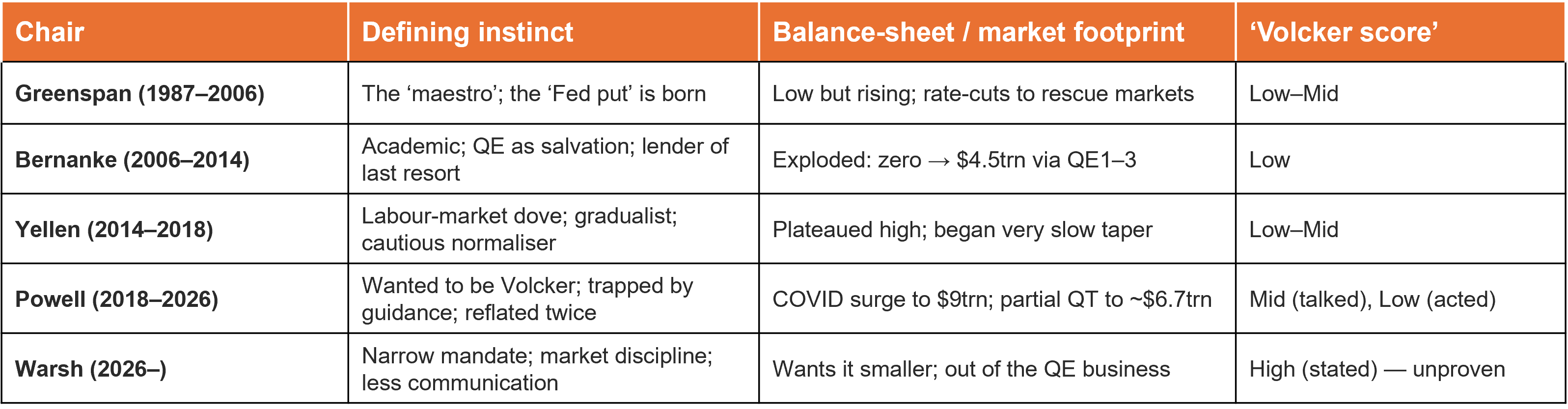
Source: Rubrics assessment. ‘Volcker score’ is a qualitative judgement of willingness to subordinate market comfort to price stability and independence.
The honest reading: Warsh is the most rhetorically Volcker-like Chair since Volcker, and unlike Bernanke he rejects the premise that the Fed is the economy’s omnipotent steward. But Powell, too, wanted to be Volcker - and was trapped. The difference, if there is one, is that Warsh is building the institutional plumbing (no dot, no guidance, task-force-driven reform) to make folding harder. The framework may impose restrictions where none were envisaged.
9. Rubrics Conclusion: Hopeful, Hedged, and Highly Timing-Dependent
We are, on balance, hopeful. The direction Warsh is steering - a smaller, quieter, less predictable, more disciplined Fed focused on inflation that lets markets discover prices and bear risk - is the right correction to two decades of moral hazard. A Fed that is feared rather than relied upon is structurally less prone to the boom-bust asset cycles that serial bailouts manufacture and cost of living rises. If he succeeds even partially, the long-run prize is a healthier capital market in which, to borrow a phrase, markets once again become weighing scales for economic success rather than voting machines for monetary liquidity.
But the cautions are serious and specific
▪ The bubble: He is attempting this on top of the largest asset bubble of the modern era. Withdrawing the implicit put from an over-valued market is correct in principle and destabilising in practice. The transition itself is the danger.
▪ No more Great Moderation: The backdrop that made activist policy look costless - stable growth, low and stable inflation, globalised disinflation - is gone. Energy shocks, rearmament, deglobalisation and AI-capex demand make the environment structurally more inflationary and more volatile. There is no longer a calm sea in which to re-rig the ship.
▪ The AI contradiction: His AI/productivity view is a latent dovish escape hatch that could reintroduce the very pre-commitment he condemns.
▪ The track record: Every predecessor talked this talk out of power and did the political thing in office - rebooting the asset bubble at the first serious drawdown. The base rate for follow-through is poor.
The decisive test is not the elegant 130-word statement of June 2026; it is the FOMC meeting that follows the first 20% equity drawdown. If he holds the line then - if the fear of the unknown Fed is allowed to do its work - this will be remembered as the moment the Fed stopped being hostage to the markets. If he folds, it will be one more Chair who wanted to be Volcker but unlike Volcker couldn’t take the heat.
10. Market Impact
Why a credible, hard-money Fed is bullish for funding costs - not bearish
Markets will read Warsh’s hard line on inflation - and his refusal to backstop asset prices - as a threat. The reality is the opposite. The economy can no longer afford the serial bailouts the old regime required, and financial markets that work for the economy rather than as an end in themselves are a far more sustainable model. A transformational Fed implies a transformed market structure.
The critical issue today is the funding overhang created by twenty years of easy money. Counter-intuitively, a credible Fed lowers funding costs rather than raising them: inflation expectations stay anchored, and the term premium avoids a rerun of the late-1970s and early-1980s. In a world where the Great Moderation is over, free trade is reversing, and the labour force is shrinking, that credibility matters more than ever.
Under this regime we would expect the term premium to flatten over the medium term and long-end rates to become better anchored. That is the true transmission mechanism: lower long rates reduce funding costs for both government and the private sector. Crucially, the US funds its private sector predominantly through long-end rates, not the fed funds rate - so for future growth, constrained long-term rates ultimately matter more than any equity-market wealth effect.
Inflating the debt away is not a realistic option given inflation-linked entitlement programmes. The first long-term goal must be controlled inflation and a stable cost of living - and, ultimately, a bond market that investors are willing to fund, given the enormous issuance ahead.
Once those conditions are met, a genuinely sustainable economy and market can emerge - one built on anchored long-end rates and credibility, not on a Fed put. The near-term cost is a more disciplined market; the long-term prize is the lower funding cost that actually drives growth.
For professional investors only. Internal Rubrics Asset Management research. Sources: Federal Reserve press materials and transcripts (Jun 2026); CNBC; CBS News; Chase/J.P. Morgan Wealth Management; Charles Schwab; Britannica Money; Wikipedia; Vested; Mervyn King, ‘The End of Alchemy’. Figures and quotations as reported to mid-June 2026. Views are Rubrics’ own and may change. Not investment advice; past performance is not a reliable indicator of future results.
Disclaimer: This communication and any attachments is confidential may contain personal information. It is intended for the addressee(s) only. Any unauthorised use, dissemination of the information, or unauthorised copying/forwarding of this message is prohibited. If you are not the intended addressee, please notify the sender immediately by return e-mail and delete this message. Any views expressed in this message are those of the individual sender, except where the message states otherwise and the sender is authorised to state them. Internet communications cannot be guaranteed to be secure or error free as information may be intercepted, corrupted, lost, arrive late or contain viruses. Rubrics Asset Management (Ireland) Limited is registered in Ireland (company number: 613956) and authorised and regulated by the Central Bank of Ireland in the conduct of financial services (reference number: C173854). Details about the extent of our authorisation and regulation is available on request. Rubrics Asset Management (Ireland) Limited does not accept liability for any errors, admission or losses which arise from this internet transmission. For more information about how and why we use personal information and who to contact with any queries about this, please see our privacy notice: https://rubricsam.com/legal/privacy-policy-2/.